

















The 10 worst excuses for not paying Minimum Wage

On the 3rd April, to coincide with the 15th anniversary of the introduction of National Minimum Wage, HMRC issued a list of the worst and most elborate excuses given to their officers in the last 12 months.
- An employer said a woman on the premises was not entitled to NMW as she was his wife. When asked what his wife’s name was the employer said “err.. her name, err what’s your name love?..”
- An employer told HMRC: “I don’t think my workers know anything about the NMW because they don’t speak English.”
- Another employer told HMRC: “When the NMW goes up I do increase the amount I pay a little, even if the total pay is still below the NMW. I don’t think its right to ignore the rises in NMW.”
- A number of employers were paying rates below NMW, suggesting that accommodation they provided workers made up for their shortfall in wages.
- Upon inspection an employer told HMRC: “I know I am paying them too little, but they are happy to work for this amount because they are getting experience.”
- An employee claimed to be just working for a few days with a view to buying the business. When HMRC checked food safety records, the employee’s name was found on historic food temperature records.
- An employer claimed they realised they were not paying employees NMW and had just this week increased their wages… to an hourly rate which was still below the minimum wage.
- An employer told HMRC: “It wasn’t a conscious decision to say ‘I’m not going to pay this’, but I’ve never really considered doing it because I’ve not had people come to me and say, ‘I’m not getting paid enough’ or ‘Is this the minimum wage?’”
- An employee ran out of the premises when HMRC officers arrived to check for NMW infringements. The same employee then returned – minus the work pinafore – pretending to be a customer.
- Another employee claimed to be a friend of the owner and only in the restaurant as they were in the area. HMRC officers returned another day to find the person in the kitchen preparing food.
Jennie Granger, Director General of Enforcement and Compliance, HMRC, said:
Most employers are honest and pay their staff the correct rate. But this research shows that some still view the National Minimum Wage as a choice and will even try these crazy excuses to avoid paying workers what they are due.
Last year, HMRC’s investigations resulted in over 26,000 people getting a share of £4 million in back pay. HMRC investigate all complaints of employers failing to pay minimum wage. We will take action to recover back pay for employees and fine employers who are not playing by the rules.
HMRC officers work hard across the UK to ensure that everyone is paid at least the National Minimum Wage, and anyone who isn’t should call us.
steve@bicknells.net
Conferences rock!

I thought as a conference I am organising is just around the corner it would be a good time to revisit the theme of professional conferences.
I have been to the CIMA Members in Practise conference for years and have always got key benefits from going:
- The conference is excellent for CPD, which as a professional management accountant, is vital. Although I don’t do tax or compliance myself I do need enough knowledge to help point clients in the right direction and conference is a good place to top up my knowledge.
- As well as specific CPD on accountancy issues we also have great key note speakers who motivate me to have the best business I can.
- Finally on the CPD front, sales and marketing is always a challenge for me and we have great workshops on how to get our messages across.
- For me, though, conference is about much more than just getting CPD. Because conference is full of like-minded individuals it is a great place to build relationships, which can carry me through the year. Working on our own can be a lonely place and these relationships help me to keep a balanced view of my world.
- And let’s not forget the gala dinner, disco, and the ‘craic’ at the bar! We have such a good time and, as I don’t get out very often, it is one of the few evenings in the year when I feel like a grown up!
I am really excited about what I will learn from this year’s conference but there is a sting in the tail.
Again I am chair of the conference (no pressure!!).
Last year the conference nightmares included not bringing the speaker slides and having to wing a presentation because one of the speakers didn’t turn up (could happen for real!). My nightmare of choice this year has been that a random eastern European pipe band crashes the event and plunges us all into chaos.
Nightmares aside I know it will all be OK because we have put many hours of preparation into it and we know we have a great programme.
So, if you are cogitating about whether to go to your professional conference (especially if you have not gone before) my advice is ‘give it a go’. You will probably get much more out of it than you ever imagined!
Fiona 🙂
Are you waiting for a New ISA?

From 1st July 2014, individual savings accounts (ISAs) will be reformed into New ISAs (NISAs) with an annual limit of £15,000.
You can invest your NISA in Cash, Stocks and Shares or in any combination.

The limits for Junior ISAs and Child Trust Funds have already been increased from £3,700 to £4,000.
From July, restrictions on corporate bonds and gilts will have the 5 year rule removed allowing you to invest in short dated securities such as Retail Bonds.
There are plans to enable Peer-to-Peer loans to be held in NISA’s but that’s still in the consultation stage.
Between now and July the most you can invest in an Cash ISA is £5,940.
So are you waiting for a New ISA?
steve@bicknells.net
Do you get tax free parking?

If you work in town or city parking costs can be high.
So if your employer gives you a parking space its a big help.
There is a tax exemption (tax and NI) for parking facilities that are within a reasonable distance of where you work and its not restricted to on-site parking.
The parking space can also be used in the evenings and weekends and isn’t restricted to the nearest car park.
You can also use Salary Sacrifice.
See EIM 21685 for further details
So yes its tax free, so why is there any confusion?
Well a few years ago (2009), we had stories like….
Commuters who drive to work face a new ‘parking tax’ of up to £350 a year.
Ministers are backing a ‘workforce parking levy’ which will come into force in Nottingham in 2012 – and is likely to be adopted across the country.The pilot scheme will see firms with more than ten parking places for staff charged £250 a year for each, rising to £350 in two years.
Connecting is key!
I have long believed that effective networking is key to business success. This is particularly so for business to business services. However, it is always difficult to decide which of the numerous networking groups are best for your particular business. It is very easy to waste time and money doing lots of ineffective networking – by ineffective I mean networking which does not result in building ‘real’ business relationships.
I believe that successful networking is less about the format and the networking organisation and more about the individuals in the group. Are they the type of people who are moving in the same markets as you? Are they talking to the people you want to talk to? Can you see yourself building great referral relationships with them? If the answer is yes to any or all of these questions the chances are you have found a netwoking group which may well work for you.
So how do you get the best out of networking meetings?
Having a plan is an excellent start. Some groups provide a list of people who have booked for the meeting so look at who is going and decide who you want to talk to. Groups with a sit down meal often give you the opportunity for you to request to sit next to a particular person – or at least on the same table as that person. So use this facility.
If you have been invited to a group by a member discuss with them in advance who in the group would be good contacts for you. If they can introduce you to each other through LinkedIn or by email in advance you will be happier approaching them at the meeting.
After the meeting FOLLOW UP! However, well you got along with the people you meet they will soon forget you if you don’t follow up with further ‘get to know you properly meetings’ (or 121s). Remember everyone in the room will be meeting lots of people all the time – you need to find a way to make sure they keep you in mind if you want them to work with you.
So, I would like to sign off by saying that it does not matter how many people you meet during your networking – what matters is how many of them you follow up and build a mutually productive relationship with.
Fiona 🙂
Time for Tax Credits
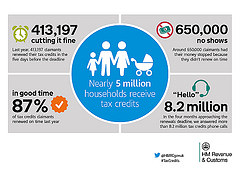
HM Revenue and Customs (HMRC) is sending out 5.8 million tax credits renewals packs which will arrive by 30 June. Over 3 million of these claims need to be renewed before the deadline for claimants to continue receiving tax credits. Last year some 650,000 claimants had their money stopped because they did not renew by the 31 July deadline.
Claimants must tell HMRC about any changes to their circumstances that they haven’t already reported, including changes to working hours, childcare costs and income, or if a partner has moved in.
Full information about renewing tax credits: ow.ly/xyPtg
HMRC 3rd June 2014
Free access to accounts filed at Companies House

60% of the 3.5 million companies in the UK now file accounts electronically and you can access those accounts free of charge via http://companies.corefiling.com/search
Paul Driscoll is a Chartered Management Accountant, a director of Central Accounting Limited, Cura Business Consulting Limited, Hudman Limited, and AJ Tensile Fabrications Limited, and is a board level adviser to a variety of other businesses.
Would you like to borrow against a single invoice?

In August 2013, the UK Government became a Buyer of invoices on the MarketInvoice Platform, investing directly in UK SMEs looking to access working capital and grow their businesses.
Why is the Government investing funds through MarketInvoice?
The UK Government, via the Department of Business Innovation and Skills (‘BIS’) and as part of the ‘Business Finance Partnership’, has committed to using alternative finance providers to channel much needed growth funding to UK SMEs. The scheme is investing £1.2 billion into increasing lending to small and medium sized businesses from sources other than banks.
How does it work?
Any company can use MarketInvoice provided its sells goods or services to other large businesses.
Its a ‘pay as you go’ service and you can see the estimated costs by using their calculator
Companies are vetted and the invoice must be to a large corporate not to other SME’s.
Its confidential so your customer will not know you have used MarketInvoice, if the customer doesn’t pay you will have to refund the investor.
So far £163m of invoices have been funded by MarketInvoice.
Of course it would be better if customers always paid quickly!
steve@bicknells.net
HMRC announce – Annual Tax Summaries are coming

Tax Summaries are part of the Government’s commitment to creating a more transparent personal tax system, one that shows individual taxpayers how much tax they are paying and how the Government spends it.
Tax Summaries will detail individual taxpayers’ income tax and National Insurance contributions for the tax year, and will include a table and chart to show how this contributes to different areas of public expenditure, such as health, education and defence and so on..
In this first year they will be issued to:
• Self Assessment (SA) customers who have registered and enrolled for online services
• PAYE customers who have receive a P2 Notice of Coding or a P800 Tax Calculation
SA customers will access their Tax Summary online. Individuals in PAYE will receive theirs by post.
Individuals who are registered for SA online will be able to view their Tax Summary soon after their tax return has been filed. It will be updated if the return is amended.
Tax Summaries are for information purposes only. You and/or your clients will not need to take any action – and you won’t need to contact HMRC when you receive it. Supporting web information will also be available.
Ruth Bulteel (HMRC) 24th April 2014
Are your charity accounts being correctly examined?
To maintain public confidence in the work of charities, charity law requires most charities (income over £10,000) to have an external scrutiny of their accounts. Provided a charity is not required by law or its governing document to have an audit then trustees may choose a simpler and less expensive form of external scrutiny called an independent examination.
Trustees may opt for an independent examination instead of an audit provided their charity’s gross income is not more than £500,000, or where gross income exceeds £250,000 its gross asset are not more than £3.26 million
Details in Charity notice CC31
Its estimated that approximately 90,000 UK charities require independent examination and that there are approximately 20,000 independent examiners.
The Charity Commission has a Framework in Notice CC32 to explain what the examiner needs to do
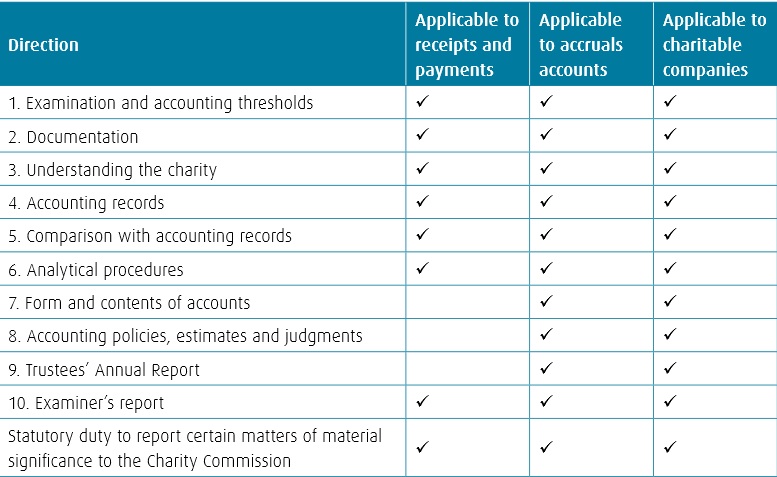
Common problems found by the charity commission include:
- The examiners report being signed by an organisation when in fact the must be signed by an individual
- Failing to address all the directives in the framework
- Insufficient scrutiny of the records
steve@bicknells.net


 Business Accountant