Business Accountant

Blog Stats

  • 132,297 hits

Enter your email address to follow this blog and receive notifications of new posts by email.

Join 1,421 other subscribers

Tax Efficiency Is Part Of A Board’s Duty To Shareholders.

MCS Corp Logo

by Greville Warwick

It is the case that we see a lot of Large and Small companies whose directors and advisers seem unaware of the availability and value of research and development tax credits and patent box. These two schemes to assist companies are actively encouraged by agencies of Government to stimulate innovation, research and development at all times.

Companies qualify, but remain unaware of qualifying criteria, which are quite simple: you must be a UK registered entity (Ltd or Plc) and a going concern for the periods claimed. If you can tick these two boxes, contact us.

mcs-corporate.com

5 Key Tests the employer must pass to borrow from a Pension Scheme

Pension concept

There are five key tests that a loan from a Pension Scheme must satisfy to qualify as an authorised employer loan. If a loan fails to meet one or more of these tests an unauthorised payment charge will apply.

The five key tests are

  • security
  • interest rates
  • term of loan
  • maximum amount of loan and
  • repayment terms.

Security [S179, Sch 30]

If a registered pension scheme makes a loan to an employer the amount of the loan must be secured throughout the full term as a first charge on any asset either owned by the sponsoring employer, or some other person, which is of at least equal value to the face value of the loan including interest.

If the asset used as security is taxable property then there may be additional tax charges under the taxable property provisions if the registered pension scheme is an investment regulated pension scheme.

Taxable property consists of residential property and most tangible moveable assets. Residential property can be in the UK or elsewhere and is a building or structure, including associated land, that is used or suitable for use as a dwelling. Tangible moveable property are things that you can touch and move. It includes assets such as art, antiques, jewellery, fine wine, classic cars and yachts.

Interest Rates [S179, Sch 30]

All loans made by registered pension schemes to employers must charge interest at least equivalent to the rate specified in The Registered Pension Schemes (Prescribed Interest Rates for Authorised Employer Loans) Regulations 2005 (SI 2005/3449). This is to ensure that a commercial rate of interest is applied to the loan.

The minimum interest rate a scheme may charge is calculated by reference to 1% above the average of the base lending rates of the following 6 leading high street banks:

  • The Bank of Scotland
  • Barclays Bank plc
  • HSBC plc
  • Lloyds TSB plc
  • National Westminster plc and
  • The Royal Bank of Scotland plc.

The average rate calculated should be rounded up as necessary to the nearest multiple of ¼%.

Term of Loan [S179, Sch 30]

The repayment period of the loan must not be longer than 5 years from the date the loan was advanced. The total amount owing (including interest) must be repaid by the loan repayment date.

Maximum Amount of Loan [S179, Sch 30]

Section 179 (1)(a) of Finance Act 2004 restricts the amount of a loan which can be made to a sponsoring employer to 50% of the aggregate of the amount of the cash sums held and the net market value of the assets of the registered pension scheme valued immediately before the loan is made. These restrictions are necessary because although such loans provide a useful source of business funding, there may be liquidity problems for the scheme if there is a sudden requirement to provide scheme benefits. It may also not be prudent to lend scheme funds to one company.

Repayment Terms [S179, Sch 30]

All loans to employers must be repaid in equal instalments of capital and interest for each complete year of the loan, beginning on the date that the loan is made and ending on the last day of the following 12 month period – known as a loan year.

Often Land and Commercial Property are used as the security for Pension Scheme loans but the problem is having first charge over the asset!

steve@bicknells.net

The price is right!

Pricing

Pricing is an area many businesses struggle with. It is part science, part art and part psychology. Confident pricing is as much about how we feel about our business and our product/service, as it is about rules and processes.

Many businesses will stick to a cost plus method of pricing. They will add up all the components of a job and add a percentage for profit – job done (?). However, this approach takes no account of the market in which they are trading or the value of their product/service to the customer.

If you don’t know enough about your market you run the risk of overpricing by using the cost plus pricing method. If other suppliers are providing the same product/service as you and charging less than you, you need to know! If you constantly loose work it may be that you are pitching to the wrong type of customer for you.

Alternatively if you don’t understand the value of your product/service to your customer, you could be regularly underpricing. Take, for example, an instance which happened to me a couple of months ago. We had just had new carpeting through out the upstairs of our house. You know how it is, for a micro second everything looks great until… the cat gets trapped in one of the bedrooms and rips up the carpet in front of the door!

I phoned our lovely carpet guy who came along and patched in some of the offcut left over from the original fitting. He did such a good job that we cannot actually see where the join is. Obviously for me this job had a good deal of value because our carpet is pristine again. But he priced on a cost plus basis and so only charged me £15! He probably left over £80 on the table because the job was worth at least £100 to me.

Now cost plus as a starting point is not bad, because at least you ensure you get the minimum price you need to cover your costs – as long as you have a very good idea what those costs are. But relying on it alone will mean that you undercharge clients for whom the value you provide is more than the costs of providing it (plus profit).

For effective pricing you need to do your homework. You need to understand the market you are in; who your ideal customers are and what they value; and you need to have a very clear idea of what you need to achieve to make a profit.

Fiona 🙂

How do you handle Input VAT on Insurance Claims?

insurance design

This often causes confusion, firstly because many people wrongly assume that IPT (Insurance Premium Tax) is VAT, it isn’t! and then when they make a claim they may get a VAT only invoice.

HMRC VIT13500 has the answer…

Insurers cannot recover any VAT incurred in obtaining replacement goods or having repairs carried out for a policy holder. The supply of goods (or services in the case of repairs) is considered to be made to the policy holder. This is so even when payment is made directly to the supplier by the insurer.

Subject to the normal rules a VAT registered policy holder may treat any VAT incurred on the supply as input tax. The insurer will normally pay the policy holder compensation exclusive of VAT. The policy holder will pay the supplier the tax and recover it as input tax.

If an insurance claim is for loss or damage at a domestic property you should make sure that any VAT claimed as input tax relates only to goods used for a business purpose.

Insurance and reinsurance is exempt from VAT under article 135 of the Sixth VAT Directive.

This also explains why an insurer may ask a contractor engaged in repair work not to invoice them VAT, its simply that they want the VAT only element to be invoiced to the insured.

steve@bicknells.net

Danger – Bad Tax Advice!

danger thin ice

Did you know that the information that HMRC give you is often incorrect?

A Civil Service Capability Review has found that one in four of us contacting HMRC is given incorrect or incomplete information. ONE IN FOUR!

That’s a massive problem.

The official message is that Self Assessment is easy, but it clearly is not true. Tax is complicated and it changes every single year. Even for small mounts of money, tax is taxing!

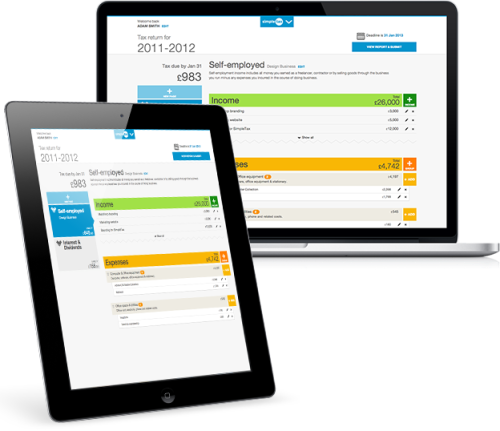
Simple Tax – a great way to file your return

https://stevejbicknell.files.wordpress.com/2014/08/laptop_ipad_simpletax_right1.png

I read about Simple Tax in an article in the Express

Backed by venture capital investors including EC1 Capital, Seedcamp and Charlotte Street Capital, SimpleTax was set up to help customers find ways to save money on their tax bills and file returns online with HMRC in minutes.

SimpleTax’s users have so far cut a total of £2.5 million from their tax bills

So I tried it out, it’s great and it’s free.

You will need your HMRC Online filing details if you want to file your return alternatively you can just print out the return.

For taxpayers who have very straightforward returns Simple Tax should make it quicker and easier to complete and file online.

As you prepare the return Simple Tax gives you tips on things you can claim and ways to save tax.

Take a look and see what you think https://www.gosimpletax.com/

For those with more complicated tax returns get advice from a CIMA Accountant.

steve@bicknells.net

Will the EBA be able to stop the growing use of Bitcoins?

Three Bitcoin digital currency coins

Back in December the European Banking Authority (EBA) issued a warning to consumers on virtual currency.

Then in July the EBA issued an opinion on virtual currencies.

The best known Virtual Currency (although not named by the EBA) is Bitcoin.

The European Banking Authority, the EBA, has called on national supervisory authorities to discourage banks and credit institutions from buying, holding or selling virtual currencies.  It calls for regulation of market participants at the interface between conventional and virtual currencies. Over the longer-term, the EBA is calling for a ‘substantial body’ of regulation to be applied to virtual currency market participants, including the creation of ‘scheme governing authorities’ accountable for the integrity of a virtual currency scheme and the imposition of capital requirements.  In the short term, the EBA is calling for national authorities to ‘shield regulated financial services from virtual currencies’.

So do you think Virtual Currencies are useful and worthwhile?


steve@bicknells.net

We love Self Employment in UK…..

Business people group.

The UK has seen the fastest growth in self-employment in Western Europe over the past year, according to the Institute for Public Policy Research (IPPR).

The number of self-employed workers rose by 8%, faster than any other Western European economy, and outpaced by only a handful of countries in Southern and Eastern Europe.

The IPPR’s analysis shows that the UK – which had low levels of self-employment for many years – has caught up with the EU average. If current growth continues, it says, the UK will look more like Southern and Eastern European countries which tend to have much larger shares of self-employed workers.

According to Tax Research UK

Something like 80% of all the new jobs created since 2010 are, in fact, self-employments, and there are a number of things that very significantly differentiate self-employments  from jobs.

The first is security:  there is none.

The  second is durability:  vast numbers of new small businesses fail, which is one reason why I doubt the official statistics.  I am sure they record the supposed start-ups  correctly but seriously doubt if they have properly counted the  failures.

Then there is  the issue of pay. The evidence is  overwhelming  that in recent years earnings from self-employment have, on average, declined significantly.

A worker’s employment status, that is whether they are employed or self-employed, is not a matter of choice. Whether someone is employed or self-employed depends upon the terms and conditions of the relevant engagement.

Many workers want to be self-employed because they will pay less tax, this calculator gives you a quick comparison between being employed, self employed or taking dividends in a limited company.

HMRC have a an employment status tool to help you determine whether a worker can be self-employed or should be an employee http://www.hmrc.gov.uk/calcs/esi.htm

In summary, why is it attractive to use Self Employed Freelancers?

  1. Skill is more important than location in many business sectors – we live in world where internet can allow you to work with anyone at anytime, you can now track down the best person to work with even if they live thousands of miles away
  2. Lower fixed costs – Using Freelancers will lower your fixed costs (in similar way to Zero Hours Contracts), you employ them for a specific project and only pay for what you need so there isn’t any surplus capacity
  3. Tax advantages – Freelancers run their own business and that means they pay less tax than employees. Employers save tax too, such as Employers NI.
  4. Competitive Advantage – You can put together a team for a contract rather than finding contracts that fit your workforce, this means you can hire the best.
  5. 110% Commitment – A Freelancers success and future work depends on them performing to the highest level on every contract, failure is not an option for a successful contractor.

So do you think self employment is good for the UK?

steve@bicknells.net

Hone your survival techniques

Small Jenny Flashdance


For many businesses the last few years have been really tough – and the next couple may be just as challenging. Although we are, in theory, out of recession the financial difficulties which come from an economic downturn will continue to be felt way into the future.

If you own a service business there are things you can do to make yourself as resilient as possible and I include my take on the most important ones below:

Credit control

In a service company the level of customer spend can be quite high. For this reason it is vital that you review the level of credit you are prepared to give clients and stick to it. My payment terms require that clients pay either by monthly standing order or on date of invoice. Even if they don’t pay immediately at least I can chase from the earliest possible point.

Ensure you invoice promptly after work is completed, and, if the job spans several months, agree stage payments with your client so they don’t owe you more than 1 months worth of work.

Bare in mind that none of us really knows what is going on in another company. A seemingly sound company can be on the verge of collapse due to cash flow problems. Credit checking services can help you assess the credit worthiness of a business, but remember their information is out of date to some degree and they don’t pick up the full picture. The only way to ensure you don’t get caught out is to collect the money owed to you as quickly as possible.

Remember, even the banks are reluctant to be banks at the moment – so don’t fall into the trap of acting like one!

The BEST

A key way to survive the recession is to provide the BEST service you can and be as close to your customers as possible. I see many service providers who think they can get away with average service and who assume clients will stick with them regardless. This is an arrogant assumption which will lead them, quite rightly, to lose good clients to much more customer orientated businesses.

For any business, but particularly for service companies, the relationship you have with your clients is king. A client who knows you well, and believes you are giving him the best, most focussed service available, is unlikely to shop elsewhere, even if he has the possibility of getting the service ‘cheaper’.

Build your referral network

We all know that people buy from people. You are much more likely to engage a supplier who has been recommended to you by a trusted advisor/contact than one you have met fleetingly at a networking event.

For this reason I think it is important to build up a network of people around you who:

– although they are not competitors to you, have the same types of customers as you do.

– understand exactly who an ideal client is for you so they can spot one when they meet them

– understand exactly what you do and the problems you solve for your clients

– are people you would be happy to refer to your contacts so the relationship is mutually rewarding

If you have a strong network you can be much more focussed in your marketing and will be much more likely to get the type of new clients you need.

At the end of the day those businesses which will remain standing will be stronger than they were before the recession, because they will have grasped exactly what makes a great business. The prize for getting it right is not only survival, but the opportunity to achieve great heights once business becomes easier again.

Fiona 🙂

Is it a Van or a Car?

black large pickup

It makes a big difference whether a double cab pick up is treated as Car or a Van for tax purposes, in summary:

  1. Benefit in Kind on Cars is linked to CO2 where as on a Van its Flat Rate (and could be zero if your private use is insignificant)
  2. Vans qualify for the Annual Investment Allowance, Cars have restricted Capital Allowances
  3. You can reclaim VAT on Vans but its much harder to reclaim VAT on cars

HMRC have some guidance in EIM23150….

Under this measure, a double cab pick-up that has a payload of 1 tonne (1,000kg) or more is accepted as a van for benefits purposes. Payload means gross vehicle weight (or design weight) less unoccupied kerb weight (care is needed when looking at manufacturers’ brochures as they sometimes define payload differently).

Under a separate agreement between Customs and the Society of Motor Manufacturers and Traders (SMMT), a hard top consisting of metal, fibre glass or similar material, with or without windows, is accorded a generic weight of 45kg. Therefore the addition of a hard top to a double cab pick-up with an ex-works payload of 1,010 kg will convert the vehicle into a car (net payload reduced to 965 kg). Under this agreement, the weight of all other optional accessories is disregarded. HMRC has also adopted this treatment.

http://www.hmrc.gov.uk/manuals/eimanual/eim23150.htm

A double cab with a payload in excess of 1000kg can still be classified as a car if the taxman dealing with the case decides it is a car. You may have to justify a genuine business need for the vehicle.

steve@bicknells.net

Follow Business Accountant on WordPress.com

Enter your email address to follow this blog and receive notifications of new posts by email.

E Mail steve@uk-accountant.org