












Business Accountant

Blog Stats

  • 132,289 hits

Enter your email address to follow this blog and receive notifications of new posts by email.

Join 1,421 other subscribers

New reporting requirements for intermediaries

11931862094_e7a9299369_z

An intermediary is any person who makes arrangements for an individual to work for a third party or be paid for work done for a third party. An employment intermediary is also commonly referred to as an agency.

From 6 April 2015, intermediaries must return details of all workers they place with clients where they don’t operate Pay As You Earn (PAYE) on the workers’ payments. The return will be a report (or reports) that must be sent to HM Revenue and Customs (HMRC) once every 3 months.

Agencies will be required to let HMRC know the following details:

  • Contractor’s name, address, date of birth, etc.
  • PAYE reference.
  • National Insurance number.
  • How the contractor was engaged during the period (i.e. was he working via a limited company).
  • The duration of each assignment.
  • Details of the contractor’s limited company (e.g. company registered number).
  • How much was paid to the contractor.

The regulations will give HMRC information that will enable it to decrease false self-employment and abuse of offshore working. This will help HMRC to:

  • support intermediaries that comply
  • penalise intermediaries that don’t comply
  • make sure the right tax and National Insurance is paid by people working through intermediaries
  • reduce unfair commercial advantage

Here is link to the full reporting requirements – Legislation Link

This is the link to consultation – Consultation

steve@bicknells.net

Letters for under 21s

Changes for employees under 21

From 6th April 2015 employer national insurance contributions will be abolished for under 21s.  If you employ anyone over 16 and under 21 years old you will need to use one of the new letters for under 21s in the national insurance category setting of your payroll software.

English: British National Insurance stamp.

English: British National Insurance stamp. (Photo credit: Wikipedia)

Secondary contribution rates

This table shows how much employers pay towards employees’ National Insurance for tax year 2014 to 2015.  The contribution rate calculated by your payroll software is set by the category letter.

Category letter £111 to £153

a week

£153.01 to £770

a week

£770.01 to £805

a week

From £805.01

a week

A 0% 13.8% 13.8% 13.8%
B 0% 13.8% 13.8% 13.8%
C 0% 13.8% 13.8% 13.8%
D 3.4% rebate 10.4% 13.8% 13.8%
E 3.4% rebate 10.4% 13.8% 13.8%
J 0% 13.8% 13.8% 13.8%
L 3.4% rebate 10.4% 13.8% 13.8%

National insurance categories

Most employees will have a category letter of A or D depending on whether or not they are in a contracted-out workplace pension scheme.  There are categories for mariners and deep-sea fisherman; the more common categories are shown below:

Employees in a contracted-out workplace pension scheme

Category letter Employee group
D All employees apart from those in groups E, C and L in this table
E Married women and widows entitled to pay reduced National Insurance
C Employees over the State Pension age
L Employees who can defer National Insurance because they’re already paying it in another job

Employees not in contracted-out pension schemes

Category letter Employee group
A All employees apart from those in groups B, C and J in this table
B Married women and widows entitled to pay reduced National Insurance
C Employees over the State Pension age
J Employees who can defer National Insurance because they’re already paying it in another job

Employees in a money-purchase contracted-out scheme

This kind of scheme ended in April 2012 but some employees might still be part of one.

Category letter Employee group
F Tax years before 2012 to 2013 only: all employees apart from the ones in groups G, C and S in this table
G Tax years before 2012 to 2013 only: married women and widows entitled to pay reduced National Insurance
C Employees over the State Pension age
S Tax years before 2012 to 2013 only: employees who can defer National Insurance because they’re already paying it in another job

How to claim zero rate of employer contributions

You should already have proof of age for all your employees.  A copy of a passport, driving licence or birth certificate will be required to show that your employee qualifies for the new zero rate of employer’s contribution.  The seven new categories are valid from 6th April and must be applied from the first salary payment after 5th April 2015 to benefit from the new zero contribution rate for employers.

What does this have to do with Auto Enrolment?

You need to have proof of age for all your employees aged under 21 to claim the zero contribution rate for employer’s National Insurance.  By the time of your staging date you must assess all your workers, based on their earnings and age.  To help you prepare for Pension Auto Enrolment you can make sure that all your employee records are up to date and that your payroll software has the full details for all workers including their date of birth.  This is a good opportunity to clean up all your employee data.

Alterledger can help

For more information on saving employer’s national insurance and preparing for Pension Auto Enrolment, contact Alterledger or visit the website alterledger.com.


Simplified Expenses – Working From Home

Beautiful young woman with coffee using laptop in the kitchen

Most people working from home were claiming the £4 per week allowance based on HMRC guidance, but this has now been updated for the self employed.

You can now calculate your allowable expenses using a flat rate based on the hours you work from home each month.

This means you don’t have to work out the proportion of personal and business use for your home, eg how much of your utility bills are for business.

The flat rate doesn’t include telephone or internet expenses. You can claim the business proportion of these bills by working out the actual costs.

You can only use simplified expenses if you work for 25 hours or more a month from home.

Hours of business use per month Flat rate per month
25 to 50 £10
51 to 100 £18
101 and more £26

Example

You worked 40 hours from home for 10 months, but worked 60 hours during 2 particular months:

10 months x £10 = £100
2 months x £18 = £36

Total you can claim = £136

Use the simplified expenses checker to compare what you can claim using simplified expenses with what you can claim by working out the actual costs.

https://www.gov.uk/simpler-income-tax-simplified-expenses/working-from-home

Alternatively you could claim you can claim a proportion (based on the number of rooms and hours of business use) of your household expenses

  • Mortgage interest or rent
  • Council tax
  • Water rates
  • Repairs and maintenance
  • Building and contents insurance
  • Electricity
  • Gas, oil or other heating costs
  • Cleaning
  • Telephone (based on usage)
  • Broadband

You can draw up a home rental agreement to reclaim these costs.

The Rental Agreement can be very basic, it just needs to show:

  • The Parties – Employee, Company, Home Office Address
  • The agreement is for use of the accommodation, furniture etc (‘the Home Office’)
  • The hours it will be used
  • The rental charge

or your could use an agreement like this one

https://www.rocketlawyer.co.uk/documents-and-forms/home-office-space-agreement.rl#

If the rental is only to cover costs (and not to make a profit) then it should not create any tax liability.

Some experts say that claiming Mortgage Interest and Council Tax can be queried but that would depend on circumstances.

There are also other isuues to consider such as VAT and Capital Gains and these are covered in the blog below.

http://stevejbicknell.com/2013/01/06/what-are-the-tax-issues-and-advantages-of-a-home-office/

steve@bicknells.net

MOTHER’S DAY OR ANY OTHER “HOLIDAY” – HOW YOUR BUSINESS CAN HAVE THE ADVANTAGE!

How many businesses do you know that really take advantage of those one off “holiday” days throughout the year like Valentine’s Day, Mother’s Day, Father’s Day, Bonfire night etc.  I hear what you are saying , Valentine’s is only for florists and chocolatiers and maybe lingerie shops, but think again……..you could be missing a trick.  Have you thought about how you could stand out from the crowd in your industry sector and steal an advantage using the “holiday” theme?

Mother’s Day

Let’s think about Mother’s Day for a minute, how could your business benefit and use this event in its marketing.  If you’re a florist, chocolatier it’s very easy to use the theme, and let’s be honest, most mums are relatively easy to buy for on Mother’s Day, beauty treatments, clothes and other gift items, but what if your business is less obviously associated with a holiday, for example if you are a “Boot camp” fitness company, which runs fitness and weight loss camps?

One way would be to run special mother and daughter camps for Mother’s Day and maybe father and son ones for Father’s Day.  This is exactly what the New You Boot camp have done with great success.  Their M.D Jacqui Cleaver thinks outside the box and uses holidays to promote offers and mailings.  Easter last year they sent out mouth-watering high-cocoa chocolate recipes and healthy recipes and as a result saw a boost to bookings.  People saw the value in the recipes, printed them off, put them on the fridge and when friends came round, it started a conversation and word of mouth referrals flowed!  It’s not rocket science, but it does take some thought, imagination and effort.

Valentine’s Day

I’m sure you can think of lots of companies doing special promotions for Valentine’s Day.  Not least the card shops with all those cards gushing with “love” messages and then of course there the usual chocolate hearts and other heart shaped gifts you see in the shops but what about the humble sausage, not something you would automatically associate with Valentine’s Day.  Heck, a family-run business making sausages, is really good at reworking its product.  This year for Valentine’s Day it created a sausage they called “PECK”, which of course was heart shaped and they managed to get it stocked by Waitrose and Tesco and as a result the MD and founder Andrew Keeble said resulted in rocketing sales.  You may remember this company if you watched the Alex Polizzi program a while back when she went in to help turn the fortunes round for the family run business.

Other “Holiday”  Days

Heck amongst others are thinking about their businesses differently, they are taking advantage of other days throughout the year to develop products on a particular theme.  Heck will be bringing out a star shaped sausage for Halloween and bonfire night.

New You Boot camp runs a fitness day in Richmond Park to coincide with Breast Cancer Awareness month and donate the proceeds to cancer charities.

What offers could you introduce for your business for the many “holidays” we have throughout the year like Christmas, Easter, even Wimbledon or rugby world cup.  There are so many events, days and “holidays” that your business could take the lead on and stand out from the crowd.  Even if you are strapped for cash, just repackage an existing product or service offering and just be a little creative.  Most businesses don’t have to do much to stand out from the crowd.

For other great tips and tools to use to make your business the business you always dreamed of grab a free download in pdf form of our book.  “Whats stopping you making your first £million profit?  Grab your copy here

Get Free Book

For more information, blog posts and guides vist our website @  www.kmaaccountancy.co.uk

Enjoy mothers day!!!

Kim
Will you pay Class 3A NI to top up your Pension?

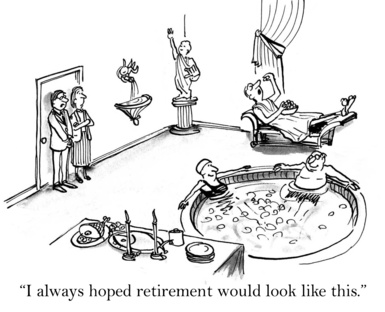
This is exactly how I pictured the partners lounge

From 12 October 2015 to 5 April 2017 you’ll be able to make a ‘Class 3A voluntary contribution’ to top up your State Pension by up to £25 per week.

You can choose to top up your State Pension by between £1 and £25 per week. How much you’ll need to contribute depends on:

  • how much extra pension you want to get each week
  • how old you are when you make the contribution

Example You are 68 years old in October 2015. You decide that you want to get an extra £5 per week (£260 a year) on top of your pension.

The cost of an extra £1 per week for a 68 year old is £827, so you multiply £827 by 5.

You’ll make a lump sum payment of £4,135.

You can use this calculator to see how it works…

https://www.gov.uk/state-pension-topup

Here is a link to the legislation…

http://www.legislation.gov.uk/ukdsi/2014/9780111121689/contents

steve@bicknells.net

Growth Vouchers – last few days!

Business people group.

Apply before 31st March to get up to £2,000 from the Government for professional business advice

• Growth Vouchers are a grant from the Government to help businesses like yours get business advice from accredited advisers.

• The voucher match-funds your investment in professional advice for your business so you could get a grant of up to £2,000 towards the cost of the advice.

You can use the voucher to get advice on:

• Finance – and how to manage your cash flow better
• Recruiting staff – how to develop their skills
• Improving management and leadership skills
• Marketing – attracting and keeping customers
• Technology – and how your business can make the most of it.

https://www.gov.uk/apply-growth-vouchers

CASH ICON

https://marketplace.enterprisenation.com/

steve@bicknells.net

Taking the Plunge!

Jenny and Michael thumbs up


Small businesses are the mainstay of the UK economy. Forget the large companies – small businesses are where it is at!

The UK is a nation of entrepreneurs and we brits are great at taking the plunge into business ownership – whether it is a self employed professionals or as small business owners employing staff.

However, for many entrepreneurs taking the plunge is not the hardest part – it is running a successful company in the longer term that provides the stress.

The problem here is that the prospective entrepreneur has often not done their homework.

In particular:

  1. They have an idea they are sure is going to work, but have not done a full business plan to explore whether it can be converted into a successful business.
  2. They have not consulted appropriate professionals to ensure their company is set up in the best way.
  3. They don’t align their personal and business goals. They soon find their business running their lives rather than them running their businesses.
  4. They don’t finance their business sufficiently from the outset, which means they can never afford to do jobs properly. Marketing in particular often suffers in this scenario.
  5. Because they haven’t planned properly they don’t fully appreciate the risks involved in setting up their business until it is too late.

Starting your own business is a BIG step. If it fails you may not just lose your livelihood but also your house (and your family if you have had to work very long hours).

It makes sense to give your business the best possible chance of succeeding.

To help I have written a guide on starting your own business which can be downloaded for free from my website www.fionabevanfinancialmanagement.co.uk

I have tried to cover all the issues you will need to think about before taking the plunge as well as some of the things which might trip you up.

Enjoy!

Fiona 🙂

The VAT advantages of a development company

Fotolia_46578927_XS home off

Property Development is a trade, where as Property Investment isn’t – renting out a residential property is a VAT exempt supply.

If you are planning significant building work, setting up a Development Company or using a building contractor might save VAT.

Assuming you employ a builder…

The VAT Rules are in VAT Notice 708 Buildings & Construction

Your builder may be able to charge you VAT at the reduced rate of 5 per cent if you are converting premises into:

  • a ‘single household dwelling’
  • a different number of ‘single household dwellings’
  • a ‘multiple occupancy dwelling’, such as bed-sits, or
  • premises intended for use solely for a ‘relevant residential purpose’

As your builder will be VAT registered, they reclaim the VAT they are charged and then charge you VAT at 5%.

If your business is property rental and you do the work yourself, you can’t take advantage of the 5% rate.

If your Development Company is VAT registered you can reclaim all the VAT.

Get your existing business or your property development company to convert the property and then sell it to another company that you own (may be an SPV)  will be a  VAT Zero Rated transaction. The other company then carries on the rental business.

steve@bicknells.net

Is Striking Off a company the best solution?

Closing down stamp

Companies House guidance states…
A company may apply to the registrar to be struck off the register and dissolved. The company can do this if it is no longer needed. For example, the directors may wish to retire and there is no one to take over from them; or
it is a subsidiary whose name is no longer needed; or it was set up to exploit an idea that turned out not to be feasible. Some companies who are dormant or non trading choose to apply for strike off. If you have
decided that you no longer want to retain your company and wish to have it struck off, the registrar will not normally pursue any outstanding late filing penalties unless you restore the company to the register at a later stage.
Form DS01 is used to apply for striking off and guidance GP4
An alternative, if the business has assets is to use an Members Voluntary Liquidation (MVL).
  1. The Insolvency Practitioner will ask your Accountant to confirm that the clients tax affairs are inorder and that appropriate advice has been given
  2. Final Accounts will need to be prepared and creditors paid
  3. A Declaration of Insolvency will be signed – The declaration of insolvency demonstrates that the company will be able to settle or secure liabilities and the costs of liquidation within 12 months
  4. A meeting of Shareholders will appoint the Insolvency Practitioner
  5. Notices will be posted at Companies House and in the London Gazzette
  6. Then the MVL can be a carried out and funds distributed
  7. Arrangements can be put in place to allow the directors access to funds during the process

Here are my top 5 reasons why an MVL might be a good choice:

  1. The change in 2012 capped capital distributions on striking off at £25,000 but this cap does not apply to liquidations
  2. You want to retire and close your business and extract the net worth
  3. You created a Special Purpose Vehicle (SPV) for a specific project and the company is no longer needed
  4. Companies that are stuck off can be re-instated but that’s not the case with liquidated companies
  5. Entrepreneurs Tax Relief may be applicable meaning the capital distribution is taxed at 10%
You may also consider disincorporation.
steve@bicknells.net
Follow Business Accountant on WordPress.com

Enter your email address to follow this blog and receive notifications of new posts by email.

E Mail steve@uk-accountant.org