











Business Accountant

Blog Stats

  • 131,773 hits

Enter your email address to follow this blog and receive notifications of new posts by email.

Join 1,421 other subscribers

Would a Partial Capital Allowance Claim reduce your tax bill?

Businessman get idea

It is not necessary to claim the maximum capital allowances available or even claim them at all, crazy as it might sound there are situations when not claiming capital allowances can reduce your tax bill!

Sole Trader Example

The personal tax allowance is currently £10,600 (2015/16)

Lets assume profits are £15,000 and Capital Allowances available are £5,000, so that would reduce taxable profits to £10,000 which would waste £600 of the personal tax allowance.

It would therefore be better to only claim £4,400 in capital allowances and claim the remaining £600 in the following year.

Company Example

Companies within a Group can only offset losses in corresponding tax periods, so if the the capital allowances increase the loss in one part of the group beyond the profits of the rest of the group then there would be no benefit to claiming them in that period.

Companies can claim capital allowances in any of the following 3 tax years.

There is an excellent example of this in the following blog http://taxnotes.co.uk/a-basic-introduction-to-capital-allowances/

steve@bicknells.net

Payroll Bureaus – Does Auto Enrolment Apply to your Director Clients?

Auto Enrolment is about to hit its peak with over 500,000 small and micro employer set to stage in 2016. With this high volume of micro employers staging early next year, it is important to know whether or not Auto Enrolment applies to your clients.

If your client has at least one member of staff who is paid via a PAYE scheme, Auto Enrolment duties will apply. The only exeption when Auto Enrolment duties does not apply is when a company or individual are not considered to be an employer.

You won’t have any duties if you meet one of the following criteria:
● you’re a sole director company, with no other staff
● your company has a number of directors, none of whom has an employment contract
● your company has a number of directors, only one of whom has an employment contract
● your company has ceased trading
● your company has gone into liquidation
● your company has been dissolved

Automatic enrolment will apply if more than one director has a contract of employment, be it a written or verbal contract. You can find out more about Automatic Enrolment for Directors here.

What if Auto Enrolment does not apply to my clients?

If your client receives a letter which includes their staging date and you believe that auto enrolment does not apply to them, you or the employer need to notify the Pensions Regulator.

To inform the Pensions Regulator, you must fill out an online form with your client’s PAYE Reference and Letter code. Notify the Pensions Regulator here.

Once you have notified the Pensions Regulator, you will receive a confirmation email and your client will no longer receive any further communications.

Change in Circumstances
Your client’s circumstance will change if a new member of staff is taken on other than a director, or if at least two directors started working for them under contracts of employment.

If this occurs, auto enrolment will now apply to your client and the employer, or you on their behalf, must notify the Pensions Regulator of the change.

However, if you do have auto enrolment duties to perform it will make it easier if you have suitable payroll software in place to automate the AE duties. BrightPay is a payroll solution that is free to employers with up to three employees or the bureau licence has unlimited employees and employers. Why not try our free 60 day trial to find out for yourself ?

BrightPay_&_AE

Written by Rachel Hynes for BrightPay Payroll and Auto Enrolment Software

Putting your accounts on Debitoor

Debitoor

I have just signed up to the Premium Pro Debitoor Account, I wanted to have online access and did a comparison to Xero, Sage, Kashflow and Free Agent. I thought Debitoor was excellent value for money (£9/mth for Premium Pro) and I have long been a fan of their online invoicing.

Debitoor is an easy-to-use invoicing and accounting software which helps freelancers and small businesses produce nice-looking, professional invoices in a matter of seconds and assists them in their accounting.

Debitoor is designed for straight forward businesses so if your business is complicated then its probably not the best option for you.

So this is how you get started:

  1. Create your contacts – Clients and Suppliers
  2. Create your Products
  3. Enter the opening balances on the balance sheet (reports) – Debitoor currently only works in calendar years (Jan to Dec) so if like me your year end falls on a different date you will need to enter the balances in the previous year, in my case my year end is March so I entered the balances in 2014 I will then do a year end and they will become the 2015 opening balances and I started entering invoices and expenses in April. I know that’s not ideal and Debitoor are constantly working on improvements, so its compromise for now.
  4. I then created multiple bank accounts – Lloyds, Directors, PayPal
  5. For expenses that I had invoices and I uploaded the PDFs of the expenses
  6. I then uploaded the bank statements for Lloyds and PayPal and reconciled and posted them

https://www.youtube.com/watch?v=-fdSzMmEsN0

steve@bicknells.net

Does your tax agent ask for too many refunds?

SA100 tax return form with calculator and pencil lying on table

High Volume Agents (HVAs) deal with large numbers of clients, often for a short time only, and make repayment claims or submit returns that generate repayments.

HVAs usually

  • provide services on a commission or ‘no repayment no fee’ basis
  • target clients in a specific trade or industry, for example the construction industry
  • submit high numbers of repayment claims relating to expenses incurred in their clients’ employment or trade
  • receive the tax repayment as a nominee for their client
  • are not members of a professional taxation accountancy body, although some of their staff may hold professional qualifications
  • have little or no face to face contact with their clients as much of their business is carried out electronically.

A repayment claim can be made using any of the following

  • P87
  • stand alone claim by correspondence
  • Self Assessment tax return
  • unsolicited return.

The range of expenses claimed that results in a repayment usually include

  • travel
  • subsistence
  • overnight accommodation
  • cost of food
  • use of home
  • wife, civil partner or relative’s wages
  • cost of tools
  • protective or specialist clothing
  • laundry
  • telephone costs.

Further details in CH820000

HMRC have targeted firms with as few as 30 clients! so don’t think it only applies to large scale operations

HMRC are particularly interested in claims where the expenses are more that 10% higher than the income.

An agent’s poor technical ability that puts tax at risk will generally fall into one or more of the following categories

  • bookkeeping or accounting errors
  • computational errors
  • lack of tax knowledge or expertise
  • unreasonable or untenable technical views.

HVA’s are asked to enter into a memorandum of understanding agreements which are designed to check clients are paying the correct tax, in general this is likely to result in higher tax payments.

So be careful who you ask to be you agent! your tax saving might be short lived.


steve@bicknells.net

#isitok – to just be a really good management accountant?

I never really knew what I wanted to do for a living, just that I was good at maths, economics & geography which pointed towards some form of business occupation. I did a degree in Accounting & Financial Analysis at Warwick Business School, without truly knowing what accounting was. After graduating I just did some temp work in an accounts office (they hired me full time within a few days) before a recruiter sat me down one day and said I needed to get my act together and get qualified if I wanted a proper career. It didn’t need much research to work out CIMA was the route to go. Following this route enabled me to become a Chief Accountant, Financial Controller then Financial Director within a fairly short space of time. All of this was in the small company environment and I was involved in every key decision, which was fascinating and rewarding! But the politics were rife and the hours were long!

The question – How can I do all the fun stuff, the analysis/reporting/decision support/director mentoring without selling my soul to the business? My answer was to go freelance and try and emulate what I had done before but across a number of businesses in different sectors. This just reinforced what I’d previously thought – I had found my vocation in life – working with owner managers or MD’s of smaller companies, understanding their aspirations, delving into the businesses, providing the right information, making a difference, adding value, finding solutions to problems, evaluating everything for them – but not taking it home every day.

During all of this I entered into the CIMA Members in Practice world, a place full of very successful people, a mix of high flying entrepreneurs, some more traditional accounting practices offering compliance as a lead service, some specialist consultants, but as far as I could see not so many freelancers like myself. At the annual conferences in the midst of all these success stories I’ve quite often sat back and thought ‘Am I doing something wrong?’ My worry was that I had no desire to build an ever expanding business, I had no appetite for compliance work, I didn’t possess a specialism where I would stand out from the crowd and I didn’t feel I needed the best looking website or my own app (or certainly couldn’t afford it). On reflection, the last 15 years has confirmed to me I’m not doing anything wrong, it’s actually ok to focus on what you feel you’re really good at.

#isitok – to just be a really good management accountant? – I think it is.

Cheers
Mark
www.avalon-ma.com

Mark Tomsett, Avalon Management Accounting Limited
Celebrating 15 years as a Freelance Management Accountant
Have you been over taxed on your pension withdrawal?

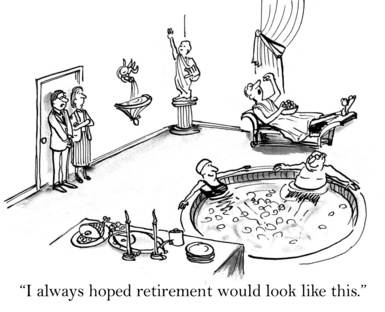
This is exactly how I pictured the partners lounge

You should be able to withdraw 25% of your pension tax free, but your pension provider will tax you on payments above this level.

If they don’t hold a current P45, the pension provider will apply an emergency tax code on a month 1/week 1 basis, which could mean you pay too much tax.

You will need these forms to reclaim the tax

Form P50Z – if the client has chosen to empty all their pension pot in one go and they have no other PAYE or pension income (other than the state pension);

Form P53Z – if the client has chosen to empty all their pension pot in one go and they do have other PAYE or pension income other than the state pension;

Form P55 – where the client has taken a lump sum payment which doesn’t use up all of their pension pot, they have only taken a single payment and don’t intend to take further payments in that tax year.

steve@bicknells.net

Weekly Work Life Balance Formula

It just occurred to me the other day that I think I’ve found a good work-life balance. Being a freelance management accountant gives you freedom to work from home and plan your own day but you also need to engage with people at your customer sites to stay in tune with how businesses thrive and survive. You also need to have some flex for the urgent customer requests, keep your education on track, fit in your business admin and plan some midday slots down the gym (it’s less busy and there are less biceps and six packs to be compared to).

Nearly everyone has key elements to their job that if balanced well could make for a better work life.

So I’ve created a formula for my ideal work life balance as a planning tool for my own work;

My Weekly Work Life Balance Formula is:
WWLB = 2.5C + 1.5H + 0.25A + 0.25E + 0.5F
© 2015 Avalon Management Accounting Limited

C = Day working at Customer Site
H = Day working at Home
A = Day of Business Admin
E = Day of Education
F = Day of Flex (for anything unplanned – if not required
 for work use for Marketing)

This formula can be applied in any order during the week and the days at home, on admin and education can be partly early morning or in the evening to allow extra social time during the usual “9-5” working day.

Have a think about your ideal formula.

Cheers
Mark
http://www.avalon-ma.com

Mark Tomsett, Avalon Management Accounting Limited
Celebrating 15 years as a Freelance Management Accountant

Can my children own shares in my company?

Young working boy with tie on computer

The s660 rules (or settlements legislation) have been around since the 1930s.

The rules stop you passing income to someone else in the family, or giving income or assets to someone else in an effort to reduce your overall tax bill. This is called a “settlement”, and the aim of the legislation is to stop people settling their income on another person who pays tax at a lower rate. (Contractor UK)

There are some interesting cases where business owners have tried to pass shares to their children unsuccessfully

Copeman v Coleman [1939] 22 TC 594

A company had been formed to take over the taxpayer’s business. He held the shares equally with his wife. Later the company created a class of preference shares of £200 each carrying a fixed preferential dividend, the right to vote if such dividend were in arrear for three years or more and the right in a winding up to a return of capital paid up. Some of the shares were taken up by his children on which they paid £10 per share. Dividends substantially in excess of the amounts paid up were then declared and the taxpayer, on behalf of his children claimed repayment of the tax paid in respect of the dividend to the extent of that child’s personal allowance. (http://swarb.co.uk/copeman-v-coleman-1939/)

Crossland v Hawkins [1961] 39 TC 493

The taxpayer, a well known film actor, agreed to work through a company for three years being paid £50 per week. The shares were transferred to his wife and accountant. His father in law set up a £100 settlement for the benefit of his children of which his wife and accountant were the trustees. The fund was used to subscribe for the remaining 98 shares. He appeared in a film for which the company was paid £25,000. The company paid a dividend which was applied by the trustees for the benefit of the children. Jack Hawkins then applied on behalf of his children for a repayment of tax to give effect to their personal allowances. The repayment claim was rejected on the grounds that the whole arrangement was a settlement of which Jack Hawkins was a settlor because he had provided the funds for it. (http://swarb.co.uk/crossland-v-hawkins-ca-1961/)

Butler v. Wildin [1989] STC 22

A company was formed by two brothers who acted as unpaid directors. Shares in the company were initially held by their infant children, which were paid out of gifts from their grandparents. The company acquired a development site using a bank loan, which was guaranteed by the brothers. The company subsequently became profitable, and dividends were subsequently paid to the infant shareholders. The High Court held that the children’s investment of ‘trifling sums’ in the shares and the parent’s provision of services to the company constituted an arrangement. An element of bounty was given by the parents in the free provision of their skill and services, and by adopting any financial risk in the company’s venture. Dividends paid to those children born before the arrangements were made (but not dividends in respect of shares transferred to children born afterwards, as there was no apparent arrangement to benefit future children) were taxable on the parents, under what is now section 660B.(http://www.taxationweb.co.uk/tax-articles/business-tax/is-that-settled-then.html)

Jeremy Vine

Which brings us to the new case of Jeremy Vine

Mr Vine appears to have been using his ten-year-old daughter Martha to avoid tax payments.

The presenter of the Jeremy Vine Show and the TV quiz Eggheads, has been funnelling cash through a limited company, Jelly Vine Productions, of which she is a shareholder.

Jelly Vine Productions had almost £810,000 in cash on its books in 2013 – the last accounts available, and £1million in 2012. 

Read more: http://www.dailymail.co.uk/news/article-2983593/Jeremy-Vine-daughter-10-shareholder-lower-tax-bill.html#ixzz3Z09xqmtO

The rules are clear on this and income given to children under 18 will be taxed on their parents so what did his advisers have in mind?
steve@bicknells.net

Will you be taxed if you inherit a Pension Fund?

Signing Last Will and Testament

IHT only applies if the pension company has to pay the value of your scheme to your estate, in which case it becomes like any other asset, but generally the pension pot is held in a discretionary trust, which means it isn’t taxed on death.

You can now nominate anyone not just dependents to be the beneficiary.

Since 6th April 2015 anyone who inherits a pension fund from a person who dies before the age of 75 is entitled to receive it tax free and the you can take the money as a lump sum or income. Once over 75 a special tax of 45% applies (previously 55%), you could reduce this by taking a regular income.

From 6th April 2016 the 45% tax is likely to be scrapped and income tax rates will be applied.

The BBC website has a useful post which explains the changes in 10 questions, click here to read it

steve@bicknells.net

A Career as a Freelance Management Accountant

During my employed career working for a range of smaller privately owned businesses I always had a vision that I could perform the FC/FD role across a much wider range of businesses. In each work role I made an impact by just doing what came naturally to me; getting stuck into the numbers, working out the key drivers, assessing the different personalities, getting the right information at the right time to the right people, planning the future with all the potential scenarios. So I took a leap of faith!

15 years on…

I realised that I’ve now spent as much time in my current career than all of my other roles put together, so it was a successful career move. It wasn’t plain sailing in the beginning, I had to fill some gaps with contract work, but I backed myself and my passion for getting the numbers right and giving true commercial insight to smaller business owners and managers. The strongest business relationships I have today go back to those first few years of trading.

In celebration of this achievement, over the next few months I plan to share some of my thoughts and experiences gained over the last 15 years. I am hoping this will provide encouragement and insight to those who are following, or planning to follow, a similar career path.

Cheers
Mark
http://www.avalon-ma.com

Mark Tomsett, Avalon Management Accounting Limited
Celebrating 15 years as a Freelance Management Accountant

Follow Business Accountant on WordPress.com

Enter your email address to follow this blog and receive notifications of new posts by email.

E Mail steve@uk-accountant.org