
Home » Small Business (Page 2)
Category Archives: Small Business
VAT for sole trader start-ups
How to maximise your VAT reclaim

Plan ahead and reclaim everything
If you are setting up a business and can ahead, you can register for VAT from the date your business will start. For most traders there is not any restriction on the date the business can start, but for some professional services eg barristers and advocates, no trade exists until they qualify. To maximise the VAT to be reclaimed, the sole trader can register for VAT in advance of date of commencement, effective the date they are due to qualify. This means that the VAT registration will be in place from the 1st day of trading and all sales invoices can be issued as VAT invoices.
Pre-registration VAT
There are specific rules allowing pre-registration VAT to be reclaimed, but any claims to recover pre-registration VAT must relate to the same trade and made by the same person. A sole trader who incorporates the business is not the same legal person as the new company. Any VAT suffered by the (unregistered) sole trader can’t be claimed as pre-registration VAT by the new company.
Get help with registering
Your accountant will be able to register you for VAT and recommend the best scheme for you. It can take a few weeks for HMRC to process applications, but accountants who are registered as agents with HMRC are likely to have a quicker turnaround time. For advice on registering for VAT and setting up your invoices, please visit the Alterledger website.
Related articles


Who cares what you think?
Are testimonials worth anything?
Many websites include “testimonials” from “customers”, but do they have any worth? If you want to attract new business it is good to be able to publish positive feedback, which helps demonstrate the value that other customers find in your service. The problem is that if reviews are obviously edited and self-selected they are not obviously representative of the views of your customers. Single line reviews taken out of context can be particularly misleading!

Use external review sites
One of the best-known review sites is tripadvisor. The greatest strength of these reviews is that hotels and restaurants etc have no control over the reviews. They have the opportunity to respond to criticism, but can’t cherry-pick the best reviews to give a false impression. The Pensions Regulator website is keen to point out that “private sector organisations we link to are not endorsed by Government and are provided for information only”; however it is worth noting that they include a link to VouchedFor on their advice page for individuals and in their guide to finding an advisor for Pension Auto Enrolment.
VouchedFor
If you are looking for a hotel you would probably prefer to check tripadvisor rather than lot of different websites for reviews. VouchedFor works along similar lines to tripadvisor, but for Accountants, Financial Advisors and Solicitors. Professionals who have a listing on the site must confirm that they recognise the name / email address of any reviewer before the review is posted online. Just like tripadvisor the professionals can’t read the review until is online so they can’t edit out any negative feedback and poor scores.
Tim Alter appeared in the guide in The Sunday Telegraph on March 29th. You can also read all his great client reviews on his VouchedFor profile!
Auto Enrolment
Many small businesses will need professional advice to help them set up a pension scheme to comply with Auto Enrolment regulations. If you are an employer and still need to prepare for your staging date, you can use an Accountant or Financial Adviser to guide you through the process. For help with setting up your payroll and preparing for your staging date, please contact Alterledger.
Related articles


New tax procedure for Directors Loans (s 455)

Its very common in Small Businesses for the Directors Loan account to be overdrawn creating a Directors Loan.
If the loan isn’t repaid within 9 months of year end the company will pay temporary additional Corporation Tax at the rate of 25% on the balance outstanding.
Section 455 CTA 2010 liabilities must be included in a company’s CT600 tax return. The S455 tax forms part of the calculation of tax payable by the company under Paragraph 8 Schedule 18 FA 1998.
A claim to relief under Section 458 is a claim for relief against the original tax charge for the AP in which the loan was made. The time limit for the claim is four years from the end of the financial year in which the loan is repaid, released or written off. COM53120
Until now there has been no set format for writing to HMRC to reclaim the s.455 tax but now you must use form L2P to enable a close company which has paid tax on a loan to a participator to reclaim that tax once the loan has been repaid, released or written off.
steve@bicknells.net
Sole Traders lose Goodwill Tax Relief

Since 6th April 2008 and until 3rd December 2014 Sole Traders and Parternships were able to claim Entrepreneurs Tax Relief on Goodwill when becoming a Limited Company.
Until the 3rd December 2014 they would claim there Capital Gains Allowance
| Period | Tax-free allowance |
|---|---|
| 5 April 2013 to 6 April 2014 | £10,900 |
| 5 April 2014 to 6 April 2015 | £11,000 |
Then claim ER which reduced the rate of tax to 10% on the gain.
But from the 3rd December they will now pay Capital Gains at the normal rates of CGT which are 18% or 28% (for Higher Rate Income Tax Payers).
This doesn’t change the potential ability of the company to offset goodwill against their Corporation Tax Return.
There are still other benefits related to goodwill as explained in this blog
The tax benefits of goodwill on incorporation?
steve@bicknells.net
Why working with accounting is about to get so much better


Anyone who works with businesses is fully aware of how important accounting is for the success of a company. Yet many business owners have a negative attitude towards accounting. A high percentage of entrepreneurs see accounting as a necessary evil and often a hindrance to starting a new company.
How is that possible? Wasn’t accounting invented to help companies manage their business?
The IT industry has brought us computers and the ability to create software to automate bookkeeping. While there is no doubt that accounting software has been a great help, when we look at the usage of it, something is wrong. More than half of the businesses in the UK keep track of their finances by using a combination of spreadsheets and word processors rather than using accounting software. In an age where computing power is ubiquitous and virtually never too far from our pocket, we should be able to do better than this.
In 2013, international accounting software provider e-conomic was considering what its next generation accounting software should look like. And decided to take a different approach. What would happen if we created a piece of accounting software for people who had no knowledge of accounting? And what if we made the basic functions free for people to use? We hoped that it would make accounting approachable by virtually anybody.
That’s how the Debitoor invoicing and accounting software was born.
Introducing simple accounting to the world
Today, more than 33,000 people in the UK and almost 300,000 people worldwide have signed up for Debitoor and have given us the privilege of approaching accounting in a different way. Debitoor is used in more than 30 countries, from the UK to South Africa, from Colombia to Australia and New Zealand.
Debitoor is an accounting package for very small businesses. It allows them to manage their customers, create quotes and invoices. It allows them to register their purchases, deal with bank and payments and helps them report their VAT directly to HMRC at the click of a button. Debitoor helps those small companies manage their assets and keep track of what’s on their balance sheet in a very simple manner. Finally, Debitoor helps business owners collaborate with their accountants by allowing them to share their data with them.
Debitoor’s mission is to make accounting cool to work with. Two years after we started, the typical reaction we get from accountants is: “Wow, convincing my clients to use this is going to be super easy!”. We have captured the essence of Debitoor in this video.
Letting users shape accounting software
But what have we done to make this possible? The most important ingredient has been a clear focus. Our mission has always been to make accounting easy for small business owners who know very little about accounting.
Here are some of the key principles we followed to build the Debitoor invoicing and accounting software:
– Approachable: We have removed any obstacles to getting started. There is no setup needed, we do not ask questions, users can start on the free package, the program is ready to go.
– Natural: We have eliminated all technical lingo. You will not find the words “debit” and “credit” in Debitoor. The workflows in the program follow the natural flows of a user with no accounting knowledge and the program uses the typical words he’d use.
– Forgiving: People make mistakes; and accounting systems typically make it quite complicated to correct mistakes. In Debitoor, actions can be undone and mistakes can easily be corrected.
– Instructive: We assume people do not know much about accounting, so we have structured the entire program to let users learn along the way. This is not just functionality but it encompasses the entire packaging of the product.
– User-driven: In an open forum, users can give their feedback and suggest new features, vote for their own or others’ suggestions and influence the further development of the software. This transparency is super important for us to develop a truly user-driven program.
– Collaborative: Most of our users share their data with their accountants in order to get help with taxes, reporting and ensuring quality.
We also had the privilege of building the product with the technology which was available in 2013. This has huge benefits for our users because it allows us to provide them with a service which is reliable, improving at a fast pace and very secure. Having a modern architecture also ensures that Debitoor is very easy to connect to other popular cloud services.
Debitoor’s user base is very diverse as its appeal is quite broad. Many of our users are freelancers, artists, consultants, designers or other creative people, but we have also small artisans and shop keepers or owners of clinics and small distributors. They all have missions and purposes in their lives and we try to help them with their accounting.
Check out the stories of Felicia Matheson from Prohibition Drinks in Newscastle, Northern Ireland and the story of Esther from The Roasting Shed in London.
Changing how an industry works
As with any change in technology, this brings great opportunities to the industry it affects. The introduction of new technology, however, takes a bit of time to mature. When television started to gain mass adoption in the 1950s, broadcasters used it as it was radio. The first shows had older men with glasses reading papers in front of a microphone. This was how it used to be with radio programs.
The availability of cloud software has created a set of providers who simply made traditional accounting software available on the internet. This, we believe, will change and we will see more and more software which is transformational in nature. That is what we are trying to do with Debitoor.
We are only at the beginning of this journey. The roadmap for Debitoor will focus on three main aspects:
1. Continue to add simple flows to support what today are very difficult accounting scenarios
2. Introduce more and more automation and intelligence to enable our users to do more with less knowledge
3. Strengthen the collaboration between users and their accountants by facilitating the sharing of data between them.
What will this mean for accountants and the accounting industry? This is what our users are telling us: They love doing their invoices and keeping track of their costs in Debitoor. It gives the nice feeling of being in control, it keeps them organized and allows them to focus on their business going forward.
At the same time, they also tell us that they need help from their accountants. They need help with taxes, they need help with reporting to authorities and a lot of them need a quality check from the experts. In addition, most of them need legal and financial advice on ad hoc issues they encounter in their life as entrepreneurs.
The biggest change for accountants is to be prepared to embrace the possibilities that technology gives us. Things like cloud storage and online applications will substitute manual processes, paper and data disks. Everything is now available via a web browser on your computer or on your phone.
In order to be successful, accountants will have focus on services that draw on their knowledge and experience and they will need to be prepared to serve their customers as they move towards those new technologies.
Increased access will not be limited to technology but also to services. This will also mean increased competition. The best thing an accountant can do is embrace change and be ahead of the curve, start small but start early. The customers are already going there.
Top 15 points in the Small Business Bill

The Small Business, Enterprise and Employment Bill is going through parliment now
The Bill will open up new opportunities for small businesses to:
- compete
- get finance to create jobs
- grow
- innovate
- export
Here are my top 15 key points:
- For every piece of legislative brought in two pieces will be removed
- Prompt Payment
- Changes to Childcare Early Years and Child Minder Registrations
- Cheque imaging from smart phones (Presentment of Cheques)
- Banks will share data on Small Businesses with other Lenders
- Invalidating restrictive terms in business contracts to increase access to Invoice Discounting
- Company Transparency – Register of People with Significant Control
- Accelerated Strike Off
- Company filing changes
- Directors Disqualification – tougher rules
- Schools, Colleges, Higher Education to track students into the labour force
- Penalties for employers who fail to pay an Employment Tribunal award
- Penalties for non compliance with National Minimum Wage increased to 100% or upto £20,000
- Improved access to alternative finance
- Streamlined Company Registration
These are major changes that will affect us all!
steve@bicknells.net
42 Business Valuation “Rules of Thumb” – are they right?

I often get asked for ‘Rules of Thumb’ for small businesses, so I have searched the internet and compiled this list, do you agree with the ‘Rules’?
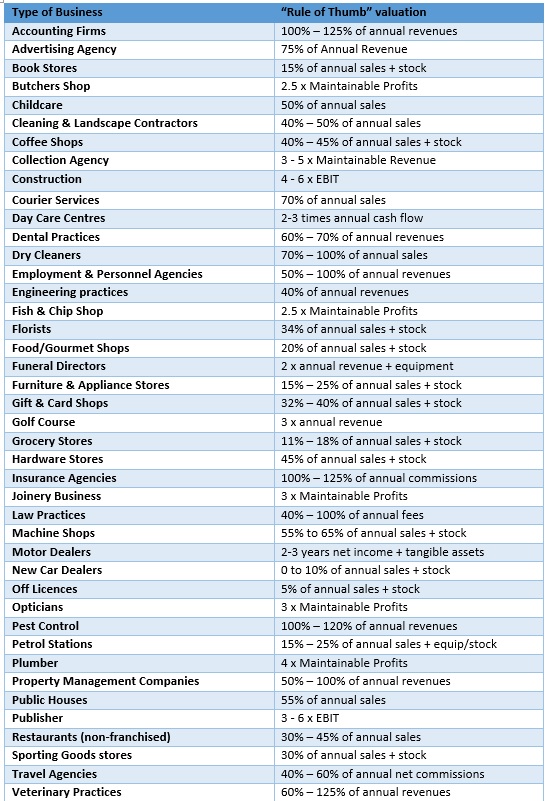
Rules of Thumb are just a starting point and many other factors need to be considered in valuing a business, it also worth considering HMRC’s views (not so good for Chefs and Hairdressers)..
Any goodwill attributable to the personal skills of the proprietor, for example the personal skills of a chef or a hairdresser, will not be transferred to the new proprietor. Advice should be obtained from the CG Technical Group if it is claimed that the goodwill attributable to the personal skills of the proprietor have been transferred with the business because his/her services have been retained for the foreseeable future by means of an employment contract. All of the relevant facts and circumstances should be established before referral to the CG Technical Group.
http://www.hmrc.gov.uk/manuals/cgmanual/cg68010.htm
steve@bicknells.net
Are you one of the third of workers with a part time business?

Almost a third of British workers run some kind of creative business outside their main job contributing an estimated £15bn to the UK economy, according to new research from Moo.com. Profitability among this group of enterprises has increased by 32% in the past year. One in ten part-time creative entrepreneurs plans to leave their job to focus on their business full-time within the next year. However, 60% said it was their passion for the business, and not making money, that motivated them. The most popular part-time creative ventures are in food and cooking, gardening, photography and knitting. (According to Law Donut)
So why are micro businesses taking off:
- You can start off working at home
- Your start up costs are low
- You can do it part time when it suits you
- With wages frozen and costs rising it can provide a useful additional income
- Its easy to be price competitive with low overheads
- The Internet makes it easy to sell your goods and services
- Your social capital can be used to generate sales ie use your contacts and connections
- There could tax advantages – employees generally pay more tax than sole traders
- Some clients prefer the personal touch
- It could be start of something big
Here are my top 20 home based business ideas:
- Get a lodger – Under rent-a-room a taxpayer can be exempt from Income Tax on profits from furnished accommodation in their only or main home if the gross receipts they get (that is, before expenses) are £4,250 or less
- Ironing and Laundry Services – Always popular and you can start with friends and family
- E Bay Trading – as E Bay say… The first task is to sort through those bulging drawers and messy cupboards, finding stuff to flog. Get a big eBay box to stash your wares in, and systematically clear out wardrobes, DVD and CD piles, the loft and garage. Use the easy 12-month rule of thumb to help you decide what to offload: Haven’t used it for a year? Flog it.
- Blogging – Blogging has taken off and many businesses are looking for people to write blogs for them
- Candle Making – You can sell the candles on line and its easy to buy the wax and things you need to make the candles
- Car Boot Sale – As with E Bay but without going on line
- Cake Making – Make sure everything is labelled correctly and you comply with Health & Safety issues
- Data Entry – The internet makes it easy to enter data from where ever you are
- Social Media – Similar to blogging, businesses need help to manage Twitter, Facebook and Linked In
- Website Design – If you have the expertise, go for it
- Sales Parties – Cosmetics to Ann Summers, there is a long list of opportunities
- Sewing and Clothes Alterations – Perfect before and after Christmas
- Jewellery – Making and selling jewellery is always popular and great for Christmas presents
- Car Repairs – Assuming you have the skills needed and comply with legal requirements
- Pet Care – Walking dogs or grooming is popular
- Virtual Assistant – Also personal organiser or personal shopper
- Wedding Planner – You could start by creating a blog about your expertise
- Direct Sales – For example http://www.netmums.com/back-to-work/working-for-yourself/direct-selling-opportunities
- Computer Repair – Great provided you have the skills
- Marketing – Telesales to leaflet design and freelance writing

steve@bicknells.net
Radio Gaga!

Last week I was given the opportunity to be part of the Packed Lunch radio programme on Glastonbury FM.
I had not previously thought about talking on the radio. But when Alan Philpott proposed the idea it appealed to me, because it gave me the chance to talk about how business owners in the local area could tackle some of their issues.
Fortunately, the programme was prerecorded so it was not too scary. I knew if I made a complete hash of it we could just start again – just as well!!
We recorded 3 15 minute slots to go out in future programmes and these first slots covered how confidence effects business performance, the benefits of business planning, and how to price effectively. Hopefully, I will have the opportunity to cover further subjects later in the year.
I have no idea whether anyone will listen but I gained from having taken part.
Doing this type of exercise reminds us that we really do know a substantial amount about our subject – which in turn makes it easier for us to be confident when talking to prospective clients. For me, it also enabled me to give some practical tips to business owners I would not otherwise reach.
So if you have the opportunity to take part in a radio programme I would definitely recommend it.
Fiona 🙂
Billy No Mates Christmas Bash 2014

I am just in the process of organising the Billy No Mates Christmas Bash for 2014.
As usual it is on the last Friday before Christmas – this year 19th December – at Beah, Union Street, Wells, Somerset. It starts at 12pm, for sit down at 12.30pm, and usually goes on well into the afternoon.
If you have been before you will know it is the office Christmas party for those of us who work on their own – or just with one other. It’s a wonderful opportunity for a pre-Christmas hair let down with like-minded business owners over a glass of wine, a superb meal and a couple of party poppers!
If you haven’t been before – why ever not?
All the details – including the menu – are on the www.billynomates.info website, just click on Wells Christmas Bash.
If you don’t live in Somerset but fancy the idea of having your own Billy No Mates bash the website also gives you some tips on how to do so. If you want us to include it on our site it all you have to do is send the details and menu to fiona@fionabevanfinancialmanagement.co.uk and we will upload it.
 Business Accountant