

Business Accountant

Home » Posts tagged 'HMRC' (Page 7)

Tag Archives: HMRC

What’s in your land? it could be worth a 150% tax deduction

Pollution

Land Remediation Relief is a relief from corporation tax only. It provides a deduction of 100%, plus an additional deduction of 50%, for qualifying expenditure incurred by companies in cleaning up land acquired from a third party in a contaminated state.

The tax releif is available on both commercial and residential developments.

Qualifying Land Remediation Expenditure can be claimed for tackling pollution, natural issues, such as radon, arsenic or Japanese Knotweed or remediating long term derelict land.

Asbestos is a common issue and qualifies for Land Remediation Relief….

Legislation in The Control of Asbestos Regulations 2006 and The Control of Asbestos Regulations (Northern Ireland) 2007 governs the way that asbestos is removed.

As a result additional costs may be incurred in containing the asbestos and dust during removal.

For example, a licensed contractor must be employed to remove high risk material, such as pipe insulation or asbestos insulating panels.

The additional costs incurred in order to comply with the regulations are part of the cost of removing the asbestos and so may qualify for Land Remediation Relief.

CIRD63200

So you don’t have to be Indiana Jones to discover value in your land…

steve@bicknells.net

HMRC aims to raise further £5bn in tax revenue

ID-10054316
Thanks to http://www.freedigitalphotos.net

Her Majesty’s Revenue & Customs (“HMRC”) are seeking new powers as follows:

1. Advance Payment – basically in any dispute between HMRC and a tax payer HMRC would be able to assess what tax they believe is due and require the tax payer to pay this as a sort of ‘refundable deposit’ until such time as the dispute is resolved through arbitration or court. Perhaps more importantly, if granted, these powers will be applied retrospectively.

Given that at the current time there are unresolved cases going back ten years or more and that once HMRC has the tax payers’ money there will be even less incentive for them to come to a resolution then this is essentially HMRC to act as judge, jury, and executioner. Isn’t this simply a ‘guilty until proven innocent’ treatment of tax payers?

2. Direct Debit – where HMRC believe that the tax payer owes them money then they will be able to simply take money directly from the tax payer’s bank account. As I understand it there will be further powers to obtain previous bank statements and this will no doubt lead to further tax investigations.

The legislation which will encapsulate these powers is currently going through Parliament, and despite opposition from lobby groups and committee members alike, HMRC seem intent upon pushing this legislation through with a view to achieving Royal ascent in mid July 2014.

Of course, should HMRC gain these powers they will hit the easy targets first i.e. those who have ‘played by the rules’ and properly disclosed everything through DOTAS, and those who operate proper business bank accounts, so it will do nothing to address those who have hidden their activities from HMRC and those who operate in the black ‘cash-in-hand’ economy.

Whilst the general public may have little sympathy for people who ‘don’t pay their fair share of tax’ (if there is such as thing – see Did Jimmy Carr just use the wrong vehicle?) we have to remember that tax avoidance is entirely legal as it simply takes the rules and regulations enacted in law and uses these to reduce a tax payer’s liability.

The new powers will do nothing to tackle tax evasion, which is illegal, and so it is no surprise that spokesmen for HMRC, and representatives for HM Government, have sought to blur the lines between legal avoidance and illegal evasion in recent times. We can be equally sure that HMRC will not be tackling the multi-nationals like Google and Starbucks who have made recent headlines with their tax affairs, and so it will (as ever) be small firms that will bear the brunt of any HMRC action.

What we shall no doubt see is an increase in non-DOTAS schemes being made available to tax payers by providers of such schemes, and I fear beyond that we shall see a rise in business insolvencies and loss of jobs, all of which will run contrary to HMRC’s aim to raise further tax revenues.

Paul Driscoll is a Chartered Management Accountant, a director of Central Accounting Limited, Cura Business Consulting Limited, Hudman Limited, and AJ Tensile Fabrications Limited, and is a board level adviser to a variety of other businesses.

Annual Investment Allowance Tips

Business people group.

What is the Annual Investment Allowance (AIA)?

The AIA was introduced in 2008. It is an allowance for tools and equipment meaning a business can write off 100% of qualifying capital expenditure (up to a set limit – currently £500,000) against taxable profits for the same period. (Expenditure over the limit is subject to the normal writing down allowances of 18 or 8 %.)

AIA is an incentive for businesses to invest because it accelerates the tax relief available, so it can all be claimed in the year of investment, rather than over a number of years, helping a business’s cash flow.

It also simplifies tax. The majority of UK businesses have qualifying expenditure less than £500,000, so they can just write this off and don’t have to make writing down allowance calculations every year.

What is the limit for AIA?

From April 2014 to 31 December 2015 AIA has been set at £500,000 per year.

From 1 January 2016 it will return to £25,000 per year.

E.g. If for the period 1 April 2014 to 31 March 2015 your taxable profits are £1,000,000 and you have spent £450,000 on qualifying capital expenditure, you can write that full amount off against your taxable profits and taxable profits will be £550,000.

Who can claim AIA?

AIA is available for companies, individuals and partnerships, where all the members are individuals.

What kind of expenditure does it cover?

It’s available for most assets purchased by a business, such as machines and tools, vans, lorries, diggers, office equipment, building fixtures and computers. It does not apply to cars.

You can find guidance on claiming AIA in the Capital Allowances Toolkit. This is one of a suite of products designed to help agents avoid errors seen in real returns.

, 25 June 2014

15 Benefits that won’t be on your P11D

trim

It’s P11D time, but have you considered giving your employees benefits in kind that are tax free, here are some to choose from:

  1. Pensions – Up to £40k can be paid in to you pension schemem by your employer (2014/15)  and you can use carry forward to pay in even more
  2. Childcare – Up to £55 per week but check the rules to makesure your childcare complies (HMRC Leaflet IR115)
  3. Mobile Phone – One per employee
  4. Lunch – Tax Free Lunch Blog
  5. Cycle Schemes – Cycle to Work Blog
  6. Fitness – Fitness Blog
  7. Parties and Gifts – Christmas Blog
  8. Parking – Parking Blog
  9. Business Mileage Allowance – 45p for the first 10,000 miles then 25p
  10. Long Service Award – A bit restrictive as you need 20 years service, the tax free amount is £50 x the number of years
  11. Eye Tests and Spectacles – The Eye Test must be needed under the Health & Safety at Work Act
  12. Suggestion Schemes – Suggestion Scheme Blog
  13. Insurance such and Death in Service and Income Protection – Medical Insurance Blog
  14. Travel Expenses – Travel Blog
  15. Working From Home – Working from Home Blog

steve@bicknells.net

Time for Tax Credits

14149276338_c43ffb6b40_m

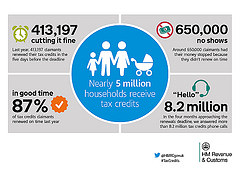
HM Revenue and Customs (HMRC) is sending out 5.8 million tax credits renewals packs which will arrive by 30 June. Over 3 million of these claims need to be renewed before the deadline for claimants to continue receiving tax credits. Last year some 650,000 claimants had their money stopped because they did not renew by the 31 July deadline.

Claimants must tell HMRC about any changes to their circumstances that they haven’t already reported, including changes to working hours, childcare costs and income, or if a partner has moved in.

Full information about renewing tax credits: ow.ly/xyPtg


HMRC 3rd June 2014


HMRC announce – Annual Tax Summaries are coming

Revenue and Customs

Tax Summaries are part of the Government’s commitment to creating a more transparent personal tax system, one that shows individual taxpayers how much tax they are paying and how the Government spends it.

Tax Summaries will detail individual taxpayers’ income tax and National Insurance contributions for the tax year, and will include a table and chart to show how this contributes to different areas of public expenditure, such as health, education and defence and so on..

In this first year they will be issued to:

• Self Assessment (SA) customers who have registered and enrolled for online services
• PAYE customers who have receive a P2 Notice of Coding or a P800 Tax Calculation

SA customers will access their Tax Summary online. Individuals in PAYE will receive theirs by post.

Individuals who are registered for SA online will be able to view their Tax Summary soon after their tax return has been filed. It will be updated if the return is amended.

Tax Summaries are for information purposes only. You and/or your clients will not need to take any action – and you won’t need to contact HMRC when you receive it. Supporting web information will also be available.

Ruth Bulteel (HMRC) 24th April 2014

Do you have a Second Income? own up now!

??????????????????????

On the 9th April 2014 HMRC launched the Second Income Campaign….

A second income could come from:

  • consultancy fees, eg for providing training
  • organising parties and events
  • providing services like taxi driving, hairdressing or fitness training
  • making and selling craft items
  • buying and selling goods, eg at market stalls or car boot sales

You need to tell HM Revenue and Customs (HMRC) if your additional income hasn’t been taxed through either:

  • your main job
  • another Pay As You Earn (PAYE) scheme
  • Self Assessment

This is called a ‘voluntary disclosure’. To get the best possible terms you need to tell HMRC that you want to take part in the campaign.

You’ll have 4 months to calculate and pay what you owe.

You can find out about the campaign and how to make a disclosure here

The criteria used to assess if an activity is a hobby or a business are:

  • The size and commerciality of the activity.
  • The frequency of the activity and transactions
  • The application of business principles.
  • Whether there is a genuine profit motive.
  • The amount of time devoted to the activities.
  • The existence of arm’s-length customers (as opposed to just selling your wares to family and friends).

If you have a Second Income its better to disclose it now rather than wait till HMRC find you.

steve@bicknells.net

Get HMRC to pay you

HMRC will pay you interest

It is not that well-known that HMRC will pay you interest on tax paid early.  The interest rate is only 0.5% though, so it isn’t going to change your life.

In the case of Corporation Tax, any payment is due 9 months and a day after your year-end.  If you have a business bank account that pays no interest and the cash to pay your tax early you can pay your tax as soon as you have filed your return.   After the 9 months is up HMRC will send you the interest calculated.

British piggy bank

What spare cash?

See my earlier post on paying your debts first. In the situation where you have cash in the bank that you aren’t putting to good use and no outstanding debts paying your tax liability early will yield a small benefit.

Get your tax return done early

It is difficult to plan your cash flow if you don’t know how much tax you are due to pay.  Even if you don’t want to pay your tax early, it is helpful to know how much cash you will need to set aside.  The later you leave it to file your tax return the more pressure you can end up putting on your cash flow.  More importantly the later you leave it, the more pressure you put on your accountant.  Most accountants increase their fees as tax deadlines approach – or to put it another way you are likely to get a discount for starting early!

Don’t be late!

It won’t surprise anyone that HMRC will charge interest on late payments.  The interest rate isn’t the measly 0.5% mentioned above but is currently 3%.  As Bank of England rate increases  – expect this to increase too!

For support and advice on preparing your annual accounts and filing your tax returns contact Alterledger or visit the website alterledger.com.


Enhanced by Zemanta

Employment Allowance

Close up of payslip

Up to 1.25 million businesses and charities will benefit from it – and around 450,000 will not have to pay any Class 1 NICs at all in 2014-15.

On 6 March, HMRC sent employers an email, headed ‘Get up to £2K off your NICs bill’, highlighting the introduction of the Employment Allowance (up to £2,000 available for the tax year 2014-15 onwards) with a link to the guidance. Almost every employer who is a business or charity (including a Community Amateur Sports Club) paying employer Class 1 NICs on their employees’ or directors’ earnings will be eligible.

Employers need to claim the Employment Allowance using their 2014-15 payroll software, or HMRC’s Basic PAYE Tools.

Ruth Bulteel HMRC

HMRC are going to let you tell them your tax code…

Close up of payslip

It’s true, from April 2014, you can tell HMRC what you think your code should be by explaining why you think its wrong, here is a link to the HMRC structured E Mail

HMRC Link

This form can only be used for queries relating to your PAYE Coding Notice. Any other queries will not be answered.

HMRC aim to respond within 15 days of receiving your E Mail.

Checking your tax code

You’ll find your tax code on:

  • your pay slip
  • your PAYE Coding Notice – you usually get this a couple of months before the start of the tax year and you may also get one if something has changed but not everyone needs to get one
  • form P60 – you get this at the end of each tax year
  • form P45 – you get this when you leave a job

Your tax code can be wrong for lots of reasons so being able to sent a structured E Mail to HMRC should help to get things corrected faster.

steve@bicknells.net