
Home » Posts tagged 'HMRC' (Page 4)
Tag Archives: HMRC
Taxman reveals top 10 terrible tax excuses

Last years excuses used in unsuccessful appeals against HMRC penalties for late filing and payment. Here’s the full list:
- My pet dog ate my tax return…and all the reminders.
- I was up a mountain in Wales, and couldn’t find a postbox or get an internet signal.
- I fell in with the wrong crowd.
- I’ve been travelling the world, trying to escape from a foreign intelligence agency.
- Barack Obama is in charge of my finances.
- I’ve been busy looking after a flock of escaped parrots and some fox cubs.
- A work colleague borrowed my tax return, to photocopy it, and didn’t give it back.
- I live in a camper van in a supermarket car park.
- My girlfriend’s pregnant.
- I was in Australia.
https://www.gov.uk/government/news/taxman-reveals-top-10-terrible-tax-excuses
The previous year, the following bizarre, exotic and flimsy excuses have all been used by tardy taxpayers:
- My pet goldfish died (self-employed builder)
- I had a run-in with a cow (Midlands farmer)
- After seeing a volcanic eruption on the news, I couldn’t concentrate on anything else (London woman)
- My wife won’t give me my mail (self-employed trader)
- My husband told me the deadline was 31 March, and I believed him (Leicester hairdresser)
- I’ve been far too busy touring the country with my one-man play (Coventry writer)
- My bad back means I can’t go upstairs. That’s where my tax return is (a working taxi driver)
- I’ve been cruising round the world in my yacht, and only picking up post when I’m on dry land (South East man)
- Our business doesn’t really do anything (Kent financial services firm)
- I’ve been too busy submitting my clients’ tax returns (London accountant)
All of these people and businesses received a £100 penalty from HM Revenue and Customs (HMRC) for filing late. They appealed against the decision using these excuses, but were unsuccessful.
https://www.gov.uk/government/news/revenue-reveals-top-10-oddest-excuses-for-late-tax-returns
Don’t be late get your return done!
steve@bicknells.net
10 ways save tax on your Self Assessment Tax Return

It’s Self Assessment season, most people who are required to do self assessment will submit their returns in December and January.
You must always send a tax return if you’re:
- a self-employed sole trader
- a partner in a business partnership
- a company director (unless it’s for a non-profit organisation, eg a charity, and you don’t get any pay or benefits, like travel expenses or a company car)
- Don’t miss the deadline of 31st January or you will get penalties and interest
- If you are new to Self Assessment makesure you get your HMRC log in details early and know your NI and UTR numbers otherwise you won’t be able to file online which could lead to penalties
- Claim all your expenses for example a self employed worker will claim for travel , protective clothing (PPE), home office expenses
- Don’t forget Pension Contributions if the tax hasn’t been claimed by your pension provider or you are a higher rate tax payer
- Don’t forget Donations to Charity if you are a higher rate tax payer
- Have you included out of pocket expenses for example parking
- If you are employee could you claim a tax allowance for clothing?
- Does your company pay mileage below the HMRC rates, you could claim a tax allowance on the difference
- Check you have all your motoring expenses included
- Makesure you have claimed all your costs on Buy to Let
steve@bicknells.net
What is the Foster Care Allowance?

All Foster Carers are classed as Self Employed and can choose whether to be taxed using one of two methods – the Simplified or Profit methods.
Simplified Method
This is the most common method.
Your ‘qualifying amount’ for a tax year consists of two parts:
- Your Annual Fixed Amount per household of £10,000
- Plus your Weekly/Part Week Amount of £200 (under 11 years old) or £250 (over 11 years old)
If your income exceeds this level under the Simplified Method your are taxed on the difference.
Profit Method
This method works best if you have high expenses, to use this method you need to keep detailed records of all your expenses including capital expenditure.
Using the Profit Method you don’t use the allowances but prepare detailed accounts on which you are taxed.
National Insurance
Foster Carers are subject to Class 2 and Class 4 National Insurance.
Further details are in HMRC Helpsheet 236
steve@bicknells.net
Is your act theatrical enough to have tax deductible agents fees?

Actors, singers, musicians, dancers and theatrical artists are permitted to make a deduction for agents fees under ITEPA 2003 S352.
But its more complicated than you might think based on recent cases…
Richard Madeley and Judy Finnegan (2006) SpC 547 it was only on appeal that the Special Commissioner agreed that their chat show was considered theatrical.
The Special Commissioners also thought that Bruce Forsyth and Ant and Dec qualified.
But that Quiz shows were borderline, for example they felt Jeremy Paxman (University Challenge) and John Humphry (Mastermind) didn’t qualify, but Anne Robinson (The Weakest Link) did qualify and Chris Tarrant (Who wants to be a Millionaire) was borderline.
So do you think the special commissioners would see your act as Theatrical?
steve@bicknells.net
Self Employed National Insurance
Changes to payment of National Insurance
HMRC has announced changes to the way that the self-employed will pay their Class 2 and Class 4 National Insurance Contributions (NIC). This is not the first time the process has changed. Some people still refer to paying their stamp – in days of old you had to buy special stamps for your NIC!

English: British National Insurance stamp. (Photo credit: Wikipedia)
No new direct debits
Until recently I would have encouraged the self-employed to set up a Direct Debit Instruction (DDI) with HMRC to pay their Class 2 NIC. From April 2015 HMRC will calculate the NIC due from your self-assessment tax return.
Deferment of National Insurance Contributions
If you currently defer NIC, you don’t need to re-apply to do so. HMRC will be sending out letters in December to everyone who currently defers NIC to confirm this. Any new applications to defer NIC will not be processed. For more information on National Insurance for the Self Employed please go to my blog post here: Class 2 NIC.
Alterledger can help
For more information on filling in your tax return, contact Alterledger or visit the website alterledger.com to see if you can organise yourself better and cut your tax bill.
Related articles

Would an online IR35 test help?

The Term “IR35” became established following a Budget press release issued by the Inland Revenue on 23rd September 1999. That press release was called “IR35”. At its simplest, IR35 is the way in which the taxman closed a loophole that was allowing many contractors and freelance professionals to avoid paying large amounts of Tax and National Insurance.
In 2012 HMRC put forward the Business Tests but they haven’t been as successful as first thought.
Here are the 12 tests, scores shown in()
- Business premises (10)
- PII (2)
- Efficiency (10)
- Assistance (35)
- Advertising (2)
- Previous PAYE (minus 15)
- Business plan (1)
- Repair at own expense (4)
- Client risk (10)
- Billing (2)
- Right of substitution (2)
- Actual substitution (20)
A score less than 10 is high risk and a score more than 20 is low risk. Fail the test and it could cost you a great deal in tax.
In general the key test tend to be:
- Substitution
- Control
- Financial Risk
HMRC launched the ESI (Employment Status Indicator) a while ago.
The recently published Minutes of the IR35 Forum’s last meeting held on 24th July reveal that HMRC are keen for contractors to be able to assess their employment status by way of the Employment Status Indicator (ESI) tool.
Will this resolve the IR35 Status problems?
steve@bicknells.net
Orchestra Tax Relief
New Creative Industries Tax Relief
The 2014 Autumn Statement from the UK Chancellor included a proposal for a new Orchestra Tax Relief.

FHM-Orchestra-mk2006-01 (Photo credit: Wikipedia)
Orchestra Tax Relief
Many orchestras are charities and therefore don’t pay Corporation Tax, but any that do pay tax may qualify for a future Orchestra Tax Relief. The tax break proposed yesterday will be going through a consultation process, so if you have an interest get involved!
Other Creative Industries Tax Reliefs
For more information on the tax reliefs for Orchestras, Theatres, Animation, Video Games and High End TV please go to my blog post here: Orchestra Tax Relief.
Alterledger can help
Why wait for the law to favour your industry? Contact Alterledger or visit the website alterledger.com to see if you can organise yourself better and claim more expenses to cut your tax bill.
Related articles

Have you got undeclared Credit Card sales?

The Credit Card Sales Campaign is an opportunity to bring your tax affairs up to date if you’re an individual or business that accepts credit or debit card payments.
Who can do this
This opportunity is for you if:
- you accept card payments for goods or service
- you haven’t declared all your UK tax liabilities
Get the best terms
You need to tell HM Revenue and Customs (HMRC) if you either:
- haven’t registered with them
- have failed to declare all your income
This is called a ‘voluntary disclosure’.
What happens if you should disclose but don’t
HMRC has details of all credit and debit card payments to UK businesses. This information is used to identify individuals and businesses that might not have paid what they owe.
Credit Card Sales Campaign Helpline
Telephone: 0300 123 9272
From outside the UK: +44 300 123 9272
Monday to Friday, 9am to 5pm
steve@bicknells.net
The tax incentive to lend to Social Enterprises?

Social Investment Tax Relief (SITR) came in on 6th April 2014.
Individuals making an eligible investment at any time from 6 April 2014 can deduct 30% of the cost of their investment from their income tax liability for 2014/15 (or the relevant later year in which the investment is made). The minimum period of investment is 3 years.
The income tax and capital gain tax reliefs provide a substantial incentive for investors. To make sure new investment is directed to the organisations which need it most and to meet EU regulations, the investment and the organisation receiving it must meet certain criteria.
Organisations must have a defined and regulated social purpose. Charities, community interest companies or community benefit societies carrying out a qualifying trade, with fewer than 500 employees and gross assets of no more than £15 million may be eligible.
The tax relief is available on unsecured loans as well as shares.
So basically, if you are a basic rate tax payer using SITR will be better than Gift Aid.
Not only do you get the tax relief but if you give a loan it will be repaid (after 3 years).
steve@bicknells.net
Have you had your annual tax statement?
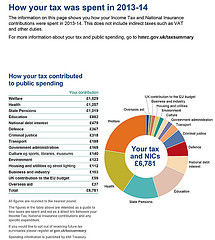
Back in 2010 the Government promised every taxpayer an annual statement of their tax position – not just the income tax and National Insurance paid, but also where the money was spent.
During October these statement started to be sent out, see the example above.
If you’re registered for online self-assessment you’ll be able to access your statement digitally by logging on to the HMRC website in the usual format, selecting the tax summary option.
Initially the statements will only cover your tax position for 2012/2013 and at first only selected taxpayers will receive one.
Is this a positive step forward or a waste of time?
steve@bicknells.net
 Business Accountant