
Home » Articles posted by Steve Bicknell (Page 10)
Author Archives: Steve Bicknell
BrightPay: Now Supporting 14 Pension Providers
The introduction of automatic enrolment means that employers across the UK must enrol eligible jobholders into a workplace pension scheme.
Employers must choose a pension scheme that meets the qualifying criteria for auto enrolment. The Pensions Regulator recommends that you choose your pension provider 6 months before your staging date to allow enough time to make the right choice for you and your staff.
There are a number of things to consider when choosing a pension provider, one of the most important being compatibility with your payroll software. Each pension provider requires information in various formats and so it is essential that your payroll software supports your chosen pension provider.
Speak to your payroll provider and ask them if your chosen pension scheme will work with your software. If it doesn’t, you should consider updating your software.
BrightPay currently supports 14 different pension providers, with more constantly being added. If your chosen pension provider is not on the list below, feel free to let us know and we can look into making it available.

The pension provider support in BrightPay allows you to create customised enrolment and contribution files for each of the pension providers, where applicable. APIs with a number of the above pension providers are also in working progress. This means that there will be a direct link between BrightPay and the pension scheme provider.
Although BrightPay supports these pension providers, the software does not choose the pension scheme provider for you. It is the employer’s responsibility to choose a relevant pension provider for their workforce.
To assist with choosing a pension scheme, The Pensions Regulator has recently released a guide to selecting a pension scheme for automatic enrolment for employers. If you need extra guidance, you can also contact an Independent Financial Adviser, but ultimately, the choice of scheme is the responsibility of the employer.

Written by Rachel Hynes for BrightPay Payroll and Auto Enrolment Software
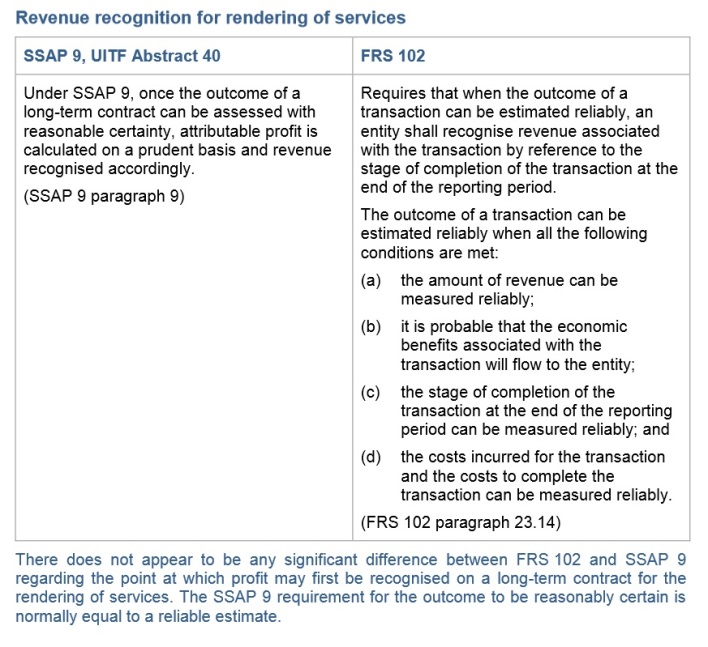
When should you recognise revenue on services provided?

The International Accounting Standard IAS 18 states
‘where the outcome of a transaction involving the rendering of services can be estimated reliably, associated revenue should be recognised by reference to the stage of completion of the transaction at the end of the reporting period’ . In other words, the revenue is recognised gradually, rather than all at one ‘critical point’, as is the case for revenue from the sale of goods. IAS 18 further states that the outcome of a transaction can be estimated reliably when all the following conditions are satisfied:
(a) The amount of revenue can be measured reliably.
(b) It is probable that the economic benefits associated with the transaction will flow to the seller.
(c) The stage of completion of the transaction at the end of the reporting period can be measured reliably.
(d) The costs incurred to date for the transaction and the costs to complete the transaction can be measured reliably.IAS 18 does not prescribe one single method that should be used for determining the stage of completion of a service transaction. However the standard does provide some examples of suitable methods:
(a) Surveys of work performed.
(b) Services performed to date as a percentage of total services to be performed.
(c) The proportion that costs incurred to date bear to the estimated total costs of the transaction.If it is not possible to reliably measure the outcome of a transaction involving the provision of services (perhaps because the transaction is in its very early stages) then revenue should be recognised only to the extent of costs incurred by the seller, assuming these costs are recoverable from the buyer.
In the UK UITF40 and SSAP9 defined the way we report revenue and profit in relation to Services, although accountants and lawyers were among the most high profile casualties of the new regime back in 2005, which forced them to re-catagorise WIP and Revenue, many other service providers also had to consider how they accounted for income. Professionals such as surveyors, architects, doctors and dentists all had to consider the impact of the new rules on their tax liabilities.
FRS102 has not changed the rules.
steve@bicknells.net
Do you know how FRS102 is changing Currency Conversion?

FRS102 affects many things and Section 30 sets out the rules on Currency Conversion.
FRS 102 states that
An entity can conduct foreign activities in two ways. It may have transactions in foreign currencies or it may have foreign operations. In addition, an entity may present its financial statements in a foreign currency
Entities will have a Functional Currency (a concept also used in IFRS) and it allows translation into a Presentation Currency
Reporting at the end of the subsequent reporting periods
30.9 At the end of each reporting period, an entity shall:
(a) translate foreign currency monetary items using the closing rate;
(b) translate non-monetary items that are measured in terms of historical cost in a foreign currency using the exchange rate at the date of the transaction; and
(c) translate non-monetary items that are measured at fair value in a foreign currency using the exchange rates at the date when the fair value was determined.
30.10 An entity shall recognise, in profit or loss in the period in which they arise, exchange differences arising on the settlement of monetary items or on translating monetary items at rates different from those at which they were translated on initial recognition during the period or in previous periods
That all sounds pretty familiar, however, as pointed out by Grant Thornton
Under SSAP 20 Foreign currency translation in current UK GAAP, where matching forward contracts are in place for a transaction, the contracted rate can be used for translation of the matched transaction. This option is not permitted under FRS 102. Instead, a foreign exchange forward contract will be recognised on the balance sheet as a financial instrument at fair value and the associated debtor or creditor will be retranslated at the year-end rate.
A key difference (FRS102) to note in comparison to SSAP 20 Foreign Currency Translation is that SSAP 20 regards consolidated goodwill as an asset of the parent company and not the subsidiary. [Steve Collings Blog]
Online traders targeted by HMRC

The Revenue has sent 14,000 letters to traders suspected of running a business and failing to declare this on their tax returns.
Of these, 1,000 letters are being sent to people where the taxman has already identified a shortfall on their self-assessment forms.
Some of those targeted make as little as £100 profit online.
It was reported in the Telegraph that eBay, Etsy, Amazon and Gumtree are being forced to hand over customer account details, including their selling activity, as part of the taxman’s legal powers that were extended last year.
The criteria used to assess if an activity is a hobby or a business are:
- The size and commerciality of the activity.
- The frequency of the activity and transactions
- The application of business principles.
- Whether there is a genuine profit motive.
- The amount of time devoted to the activities.
- The existence of arm’s-length customers (as opposed to just selling your wares to family and friends).
HMRC have some great examples to help you decided, for example
Gail is a full-time employee working for a stationery company. She pays her PAYE tax on this employment every month.
In her free time Gail makes cushions and uses most of them in her home. Occasionally she sells them to friends and work colleagues for an amount that just covers the cost of materials of £15. Sometimes she makes a loss. Any money she does make goes towards her holiday fund.
She decides to make extra cash by selling cushions on an Internet auction site and starts auctioning three or four to see how they go. They all sell for more than £50, a profit of at least £35 each.
She uses this money to buy more materials and within a month she is selling around ten cushions a week, always at a profit, and is considering setting up her own website.
Gail’s initial sales of cushions to friends are not classed as trading. It lacks commerciality and she does not set out to make a profit. The occasional sales are a by-product of her hobby. Once she begins to auction her cushions, she has moved into the realms of commerciality.
She is systematically selling her goods to make a profit. She will need to inform HMRC about her trade, and keep records of all her transactions. On the level of sales shown in the example the potential turnover of around £26,000 is well below the VAT annual threshold so Gail does not need to register for VAT.
Many traders start off in a small way and don’t realise that they need to register with HMRC, they assume their activity will be treated as a hobby, but things can grow quickly.
You should register as Self Employed as soon as your hobby becomes a commercial venture, even if you are losing money!
If you don’t register, HMRC will be looking for you and if you have an online business it won’t be hard for them to find you.
steve@bicknells.net
Overhead allocation using ABC

CIMA Official Terminology describes activity-based costing as an approach to the costing and monitoring of activities, which involves tracing resource consumption and costing final outputs. Resources are assigned to activities and activities to cost objects. The latter use cost drivers to attach activity costs to outputs.
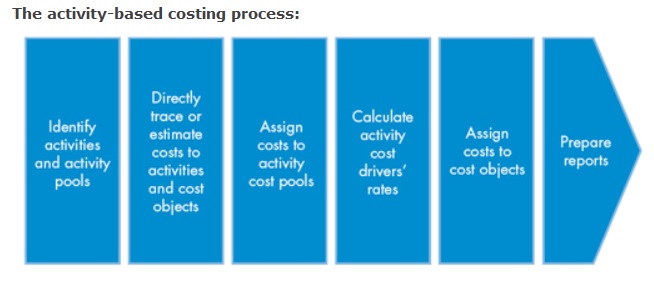
What are Activity Pools and Cost Drivers?
Activity Pools
- Purchase Orders
- Machine Set Ups
- Packaging
Cost Drivers
- Number of Purchase Orders
- Number of Machine Set Ups
- Number of items to package
What would the traditional methods of allocation have been?
- Direct Labour Hours
- Machine Hours
- Floor Area
Using Activity Based Costing can produce very different results to Traditional Methods, click here for an example
steve@bicknells.net
Do you use the Employment Status Tool?
Determining whether a worker is Employed or Self Employed isn’t always easy.
HMRC updated and improved their tool in April 2015.
The Employment Status Indicator (ESI) tool enables you to check the employment status of an individual or group of workers – that is whether they are employed or self-employed for tax, National Insurance contributions (NICs) or VAT purposes.
The ESI tool is essential for anyone who takes on workers, such as employers and contractors. (The tool refers to anyone in this position as an engager.) Individual workers can also use the tool to check their own employment status.
The tool cannot, however, be used to check the employment status of certain workers:
- company directors or other individuals who hold office
- agency workers
- anyone providing services through an intermediary (sometimes referred to as IR35 arrangements)
The ESI tool is completely anonymous, so no personal details about the worker or engager are requested.
Click here to use the HMRC Tool

steve@bicknells.net
Have you accrued for Holiday Pay correctly? Section 28 FRS102

Most larger businesses, especially if they are audited probably already accrue for Holiday Pay but not every business has been accruing the cost. FRS102 Section 28.1 will require that holiday pay is accrued. Here is an example from the FRC.

Holiday pay isn’t always easy to calculate for example if you have part time employees or casual workers, Gov.uk have a calculator to help work out the entitlement – GOV.UK Holiday Calculator
The next issue is the rate of pay, for some employees with regular hours its easy but for those with fluctuating rates, bonuses etc a 12 week average is used as explained by ACAS
On 4 November, the Employment Appeal Tribunal (EAT) ruled that holiday pay should reflect non-guaranteed overtime. Non-guaranteed overtime is where there is no obligation by the employer to offer overtime but if they do then the worker is obliged by their contract to work that overtime.
The Government set up a taskforce to consider the possible impact of the EAT’s ruling on holiday pay. Regulations were laid out on 18th December 2014 to limit claims for unlawful deductions from wages to two years. The rules apply to Employment Tribunal claims made on or after 1 July 2015.
Further details at ACAS Calculating Holiday Pay
steve@bicknells.net
When can you make a Prior Year Adjustment?

Until FRS102 basically an error had to be Fundamental for a Prior Year adjustment to be justified
This position is about to change with arrival of FRS 102. Paragraph 10.21 states that ‘an entity shall correct a material prior period error retrospectively in the first financial statements authorised for issue after its discovery’. This means that, on adoption of FRS 102, the threshold for correcting an error by use of a prior period adjustment has reduced from fundamental to material (ICAEW)
Any excuse will do to avoid £100 Self Assessment Penalty

In June the BBC announced..
People who have filed late tax returns have been let off paying a £100 fine for missing the deadline, HM Revenue and Customs has confirmed.
steve@bicknells.net
Is my Grant Capital or Revenue?

A grant is an amount of money given to an individual or business for a specific project or purpose.
You can apply for a grant from the government, the European Union, local councils and charities.
Advantages include:
- you won’t have to pay a grant back or pay interest on it
- you won’t lose any control over your business
Financial assistance in the form of grants is subject to the normal taxation rules, as supplemented by S105 Income Tax (Trading and Other Income) Act 2005 and S102 Corporation Tax Act 2009 (see BIM40465). Under normal rules the tax treatment of grants will depend on whether they are capital or revenue.
Revenue grants
Grants which meet revenue expenditure, such as interest payable, are normally trading receipts.
See also Smart v Lincolnshire Sugar Co. Ltd [1937] 20TC643 and Burman v Thorn Domestic Appliances (Electrical) Ltd [1981] 55TC493.
Capital grants
Grants which meet capital expenditure are normally not trading receipts.
Grants that may be capital in nature include those paid to acquire capital assets or to facilitate the cessation of a trade or part of a trade.
See The Seaham Harbour Dock Co. v Crook [1931] 16TC333).
A capital grant reduces any qualifying capital expenditure for capital allowance purposes, see CA14100.
See BIM40451 for more details
The Accounting Rules are set out in section 24 of FRS102, neatly explained by Steve Collings in his blog, click here to read it
steve@bicknells.net
 Business Accountant