

A SRIT idea
Will Scottish taxpayers pay less?
From 5th April 2016 a new Scottish Rate of Income Tax (SRIT) will come into force in Scotland. Although is it currently anticipated that taxpayers in Scotland and the rest of the UK will pay the same rate of tax next year, it is likely that the regions will diverge in coming years as more power is devolved to Scotland.
Who is Scottish?
The criteria applied to determine Scottish taxpayers are based on where the individual lives, and not where they work or their feeling of national identity. All of the following would be classed as a Scottish taxpayer:
- WILLIES (Working In London Living In Edinburgh)
- Scottish Parliamentarians (regardless of where they live)
- People living and working in Scotland
- People living in Scotland and working across the border in Carlisle / Newcastle etc
Who decides?
HMRC are responsible for assessing whether or not someone is a Scottish taxpayer. Anyone that HMRC deems to be Scottish based on their principal residence will be issued with a new S tax code. Your payroll software should automatically process the SRIT for anyone with a new S code. As with student loans, it is not for the employer to use their own judgement about applying the SRIT. If an employee disagrees with their tax code, it for the employee to resolve this with HMRC. Employers must act on instructions from HMRC.
Do English employers need to do anything?
Even if your business operates exclusively in England (or any other region of the UK outside Scotland) you will need to comply with regulations as they apply to any of your employees who live in Scotland. Surprisingly, there is no legal obligation to inform HMRC if you move and although employers really ought to know where their employees live, it might not always be obvious, especially if an employee has more than one residence.
Common misconceptions
It is common to think that any of the criteria below qualify for Scottish taxpayer status, but it isn’t the case.
- National identity
- Place of work
- Where income is generated (eg property income in Scotland)
- Regular travel to Scotland
Will Scots benefit?
The costs of the SRIT are to be borne by the Scottish Government. HMRC currently estimates that the total costs of implementing SRIT will be in the range of £30 million to £35 million over the seven-year period from 2012-13 to 2018-19. This is split between IT expenditure of between £10 million and £15 million, and non-IT expenditure of £20 million. The additional annual costs of operating the SRIT will be between £2m and £6m. The lower estimate corresponds to a SRIT where Scots pay the same rate as the rest of the UK. If the SRIT diverges from the neutral rate of 10%, the costs rise in administering the tax regime in the UK including pensions, gift aid and disputes over residence.
Why is the SRIT being introduced?
Scotland as a whole is likely to be worse off as any difference in tax raised is offset by an adjustment to the block grant from Westminster. It is estimated that 2.6m people will be issued with an S tax code. The annual running costs are therefore less that £3 per taxpayer but it is a valid question to ask if it is a good use of taxpayer’s money if tax rates are the same across the UK. It is anticipated that after additional powers are introduced in 2017 the SRIT could be more progressive, meaning that wealthier individuals would pay a higher proportion of tax. For anyone thinking about their residence status and still had a choice, now is a good time to get advice on the best situation for you!
More information
For more information on the SRIT and for guidance on operating your payroll scheme, please contact Alterledger.
Related articles


What are the tax implications if a company pays a Directors personal expenses?
It’s not uncommon for Directors personal expenses to get mixed up with business expenses, for example the director is out buying things for the company and picks up some items for themselves at the same time and it goes on the same bill.
In a perfect world the Director would just repay the cost of personal purchases to the company, but we don’t live in perfect world, so what are the options?
Directors Loan Account
You could post the cost to the Directors Loan Account. These accounts are normally repaid when the Director is paid either salary or dividends.
If the loan is not cleared by year end then the company will have to pay a temporary corporation tax charge of 25% and reclaim the tax when the loan is repaid using form L2P
There may also be a notional amount of interest (4%) charged as a benefit in kind on the loan.
Benefit In Kind
You could have the expenses as a benefit in kind, some benefits may even be tax free, here is a list of my favourite tax free benefits
- Pensions – Up to £40k can be paid in to you pension scheme by your employer (2015/16) and you can use carry forward to pay in even more
- Childcare – Up to £55 per week but check the rules to makesure your childcare complies (HMRC Leaflet IR115) – new rules coming soon
- Mobile Phone – One per employee
- Lunch – Tax Free Lunch Blog
- Cycle Schemes – Cycle to Work Blog
- Fitness – Fitness Blog
- Parties and Gifts – Christmas Blog
- Parking – Parking Blog
- Business Mileage Allowance – 45p for the first 10,000 miles then 25p
- Long Service Award – A bit restrictive as you need 20 years service, the tax free amount is £50 x the number of years
- Eye Tests and Spectacles – The Eye Test must be needed under the Health & Safety at Work Act
- Suggestion Schemes – Suggestion Scheme Blog
- Insurance such and Death in Service and Income Protection – Medical Insurance Blog
- Travel Expenses – Travel Blog
- Working From Home – Working from Home Blog
Private Use of Company Assets
It may also be worth considering private use of company assets.
- The cost of the asset is allowed against Corporation Tax and you can claim Capital Allowances and the Annual Investment Allowance.
- The Assets could be purchased from the Director but they must be transferred at Market Value.
- The Benefit In Kind is generally 20% of the market value
steve@bicknells.net
Will Small Businesses be exempted from VAT MOSS?

Before 1st January 2015 all businesses supplying telecommunications, broadcasting and e-services such as downloaded ‘apps’, music, gaming, e-books and similar services to private consumers located in other EU Member States (referred to as ‘B2C’ supplies) were taxed where the business supplier was established, which is simple to understand and implement.
Since 1st January 2015 VAT is now charged in the country where the customer has ‘use and enjoyment’ of the services.
So lets say you are an American (normally zero rated) on holiday in France, even though you pay with an American credit card and buy from a UK supplier because you are reading your ebook in France, French VAT will apply. Sounds like a nightmare, doesn’t it.
To help with this HMRC introduced the VAT MOSS (Mini One Stop Shop).
Overview
If your business supplies digital services to consumers in the EU, you can register with HM Revenue and Customs (HMRC) the VAT Mini One Stop Shop (VAT MOSS) scheme. There are 2 UK VAT MOSS schemes that operate in an almost identical way:
- Union VAT MOSS scheme for businesses established in the EU including the UK
- Non-Union VAT MOSS scheme for businesses based outside the EU (for example, the USA, Canada, China)
By using the VAT MOSS scheme, you won’t have to register for VAT in every EU member state where you make digital service supplies to consumers.
Once you register for a UK VAT MOSS scheme HMRC will set you up automatically for the online VAT MOSS Returns service.
You need to submit a single VAT MOSS Return and payment to HMRC each calendar quarter. HMRC will then forward the relevant parts of your return and payment to the tax authorities in the member state(s) where your consumers are located. This fulfils your VAT obligations.
Unless businesses opt to register for MOSS, businesses that make intra EU B2C supplies of telecommunications, broadcasting and e-services will be required to register and account for VAT in every Member State in which they have customers. MOSS will give these businesses the option of registering in just the UK and accounting for VAT on supplies to their customers in other Member States using a single online MOSS VAT return submitted to HMRC. This will significantly reduce their administrative burdens.
- Examples of telecommunications services include: fixed and mobile telephone services; videophone services; paging services; facsimile, telegraph and telex services; access to the internet and worldwide web.
- Examples of broadcasting services include: radio and television programmes transmitted over a radio or television network, and live broadcasts over the internet.
- Examples of e-services include: video on demand, downloaded applications (or “apps”), music downloads, gaming, e-books, anti-virus software and online auctions.
Fiscalis conference (7th to 9th September 2015)
Representatives from all EU finance ministries were at the Fiscalis conference in Dublin last week to discuss the implementation of the new EU VAT rules, and how they have been working since their introduction in January 2015.
Accounting Web reported …
One of the key takeaways from the consultation was a general agreement that there should be a threshold to exempt smaller businesses from the rules. The commission stated that it intends to propose legislation for a threshold beneath which companies will be VAT exempt, but did not confirm a figure.
There was also a general agreement that above this threshold there should be what many are calling a ‘soft landing’: A simplified version of the rule for businesses that does not create a financial cliff for those who hit the threshold.
Let’s hope that an exemption can be put in place very soon and ideally as proposed in the EU VAT Action Campaign below
EU VAT Action Campaign (started 28th August 2015)
Please circulate this article as widely as possible, as soon as possible, with as many of your business contacts and other networks.
Write to your national tax authority and finance ministry, to your MPs, MEPs, other elected representatives and to any business organisations which you belong to, insisting that the EU act immediately to:
1. Introduce a threshold of €100,000 for cross-border trade (i.e. based on how much you’re selling digitally to the rest of the EU, outside of your home country). As far as your domestic turnover is concerned, your own country’s VAT rules will still apply.
2. Simplify the rules for all micro businesses (i.e. sub-€2m turnover) to allow ONE piece of data as evidence of place of supply, instead of the current 2-3, with that piece of data being the customer location as supplied by the payment processor to businesses using all levels of their services, not just to those purchasing premium options.
3. Immediately suspend these rules for micro businesses, so that they can revert to their domestic VAT rules and pay taxes according to those regulations during the 2 years it could take for the agreed idea of a VATMOSS threshold to become law.
4. Amend the legislation so that all Member States are legally required to direct their VATMOSS communications through the business’s home tax authority for all micro businesses, to remove the threat and fear of receiving demands and ‘system error’ letters from 27 different tax authorities.
One last thing; please take the few extra minutes to contact these people direct rather than using a bulk-emailing service. These websites have become a victim of their own success in flooding inboxes, so letters coming via these routes are increasingly ignored. You can still send the same letter to them all but you will need to copy and paste and send it individually to be most effective.
steve@bicknells.net
Introducing BrightPay Payroll & Auto Enrolment – Online Training for Accountants
Auto enrolment is well on its way and it’s definitely here to stay. The vast majority of employers want help with the auto enrolment setup and ongoing duties. Here at BrightPay we have worked hard to automate and simplify the AE process for payroll bureaus. By streamlining AE with payroll technology you will make your life easy.
BrightPay is a powerful payroll and auto enrolment software that makes managing payroll easy. For bureaus, BrightPay is an easy to use solution with no limitations on the number of employees or employers that can be processed.
BrightPay automates automatic enrolment for you including employee assessment, batch enrolment, personalised tailored communications, postponement, opt-ins, opt-outs & refunds, ongoing monitoring, required reporting and calculations for AE pension providers and much more.

This training webinar will take you through the payroll process from setting up an employer to submitting your RTI submissions. Discover how easy it is to process auto enrolment for your payroll clients. You will learn how BrightPay can automate the AE duties and save you time in the process. Find out why BrightPay has a 99.3% customer satisfaction rate with 99.5% of customers describing our interface as user friendly.
NEST web services / API
This week, BrightPay will release the new NEST web services or API tool to their customers. This tool will be of significant use for accountants that process payroll for a number of clients. The NEST web services allows users to submit their data file from within the BrightPay interface directly to NEST. This process will be demonstrated on the training webinar.
Webinar Date: 8th December | 2.00 pm
Introducing BrightPay Payroll & Auto Enrolment – Online Training for Accountants

Website: http://www.brightpay.co.uk
Ways a Relevant Life Plan can help you – let the tax man pay for your life cover…

If you are an accountant this could be great fit for you and your clients, if you have life insurance why not place that cost on company expenses. Either way anyone who pays for life cover out of their own account can now benefit if they are LTD company Director. Life is full of examples of people buying exactly the same thing but for very different reasons. A Relevant Life Plan is no different. We took a moment to ask a few of our clients why they chose to go with a Relevant Life Plan. A few of their responses are below:
- “I am a business owner and heard a shocking statistic that businesses in the UK are terrible at putting in place adequate business continuity plans. The result is that of those without plans, 70% will go out of business within two years if they were to lose a key person.
- I didn’t want my business to be one of the 70%, so I took out a tax-efficient Relevant Life Plan to ensure if the worst ever did happen, there would be the funds to support the business and its employees through a difficult time.”
- “Now we have kids, I was conscious how financially vulnerable my family would be if I was to die. I’m an IT contractor and the sole source of income for the family. We enjoy a very comfortable lifestyle now and I wanted to help secure the financial security of the family if something were to happen to me. A Relevant Life Plan was an incredibly tax-efficient way for me to achieve this.”
- “I am an employer running a small business. It is often difficult for us to compete with larger employers on salary and benefits to attract the best staff. When I heard about Relevant Life Plans and how tax-efficient they were, for both the business and employee, I immediately recognised here was an affordable opportunity for me to be able to offer our staff a benefit akin to the bigger companies.It was a no-brainer to help retain and attract the best people.”
- “As a business owner, I am always looking to save tax.When a client mentioned their Relevant Life Plan and how it allowed them to put their life insurance through their business, with no need to put it on their P11D, I couldn’t believe it. Not only did it save them personally tax and NI, it was also a fully tax-deductable business expense, thereby reducing the business’ Corporation Tax liability too. When I heard that it was all HMRC-approved I didn’t hesitate to get a policy in place for myself.”
You can see from the small sample of responses above the array of reasons that someone takes out a Relevant Life Policy. What they all had in common was the tax-efficient nature of the plan.
Whatever your motivation is for looking into a Relevant Life Plan, we can assure you that you’ll be as delighted as the 1000s of other people that have taken out a tax-efficient Relevant Life Policy already.
For more information on relevant life plans please contact Tom Hitchcock at Broadbench on 01202 978663.

|
Thomas Hitchcock
Director, Broadbench Ltd p:01202 978663 | m:07813142121 | e:tom.hitchcock@broadbench.co.uk | w:www.broadbenchglobalbenefits.com | a:2 Stanley Road, Poole, Dorset. BH15 1QY
|
What if you write off an inter company or directors loan?

Connected party loans are a problem area especially if the loan is impaired (ie the borrower may not be able to repay the debt)
Individual Loans written-off
If an individual makes a loan to a company and this is subsequently written-off, the company will have a non-trading loan relationship credit equal to the amount written off.
If the loan was made to an unquoted trading company, the individual will crystalise a capital loss equal to the amount of the loan written off. This will be available to set off against capital gains arising in the year of write-off or in subsequent years.ACCA
Loans swapped for Shares
Often Loans are swapped for equity and then subsequently a claim for negligible value is made.
A negligible value claim enables you to set a capital loss against your income (or against other capital gains if you have them) for earlier years and claim a tax refund.
Many negligible value claims are made by shareholder directors whose company has failed. Their claim is to offset the loss on the shares in their company against their directors’ wages for earlier tax years.
When a taxpayer owns shares which become of negligible value the taxpayer may make a claim under s24 TCGA 1992, resulting in a deemed disposal and reacquisition, which crystallises a capital loss.
Intercompany Loans
Accounting standards require companies to assess their assets at the end of each period to ascertain whether there is objective evidence that particular assets are impaired. So if a loan can’t be repaid it would be impaired and may require a provision for bad or doubtful debts at the year-end which may well lead to the eventual release of the loans in question.
The problem is that for connected businesses this can create a double whammy on tax! tax relief is denied in respect of the debit to the creditor company’s profit and loss account. The credit recognised in the debtor company’s accounts can be taxable.
Where the creditor and debtor are connected companies, the connected party rules will apply to the release. This means that the release debit in the creditor’s accounts will not be allowable, because of CTA09/S354. Similarly, the credit in the debtor company’s accounts will not be taxable, since CTA09/S358 applies, unless the release is a ‘deemed release’ as defined in CTA09/S358(3) (CFM35440) or a ‘release of relevant rights’ under CTA09/S358(4) (CFM35510).
Since the release is, for both parties, dealt with under loan relationships, the priority rule in CTA09/S464 means that the creditor’s loss cannot be claimed, nor the debtor’s profit taxed, under the normal provisions for trading income. Nor can the credit in the debtor’s accounts be taxed under CTA09/S94 (debts incurred and later released).
Trade debts or loans between companies within a group may not uncommonly be released when either the debtor or the creditor company (or both) is dormant, as part of a ‘tidying-up’ exercise to enable dormant companies to be struck off. If this is all that happens, HMRC would take the view that the recording of an accounts profit – which is not taxed – in a dormant debtor company does not result in that company starting to carry on a business, and therefore does not start an accounting period under CTA09/S9. HMRC CFM41070
Two companies are connected for an accounting period if one controls the other or both are under the control of the same person (s 466) and companies are connected for the whole of their respective accounting periods if the control test is met at any time during those periods.
One possible solution could be a Deed of Release or Waiver executed in the accounting period in which the loan is released, but this would need to be properly drafted. The credit to the debtor company’s profit and loss account will then be able to be treated as non-taxable and as such avoid the double tax treatment.
steve@bicknells.net
4 Tips for Choosing Cloud Accounting Software

There are lots of brilliant accounting solutions on the market, so how can you decide which one will work best for your business?
Features
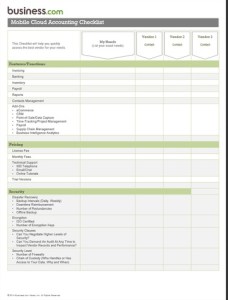
The first thing you need to decide is what features you need:
- Projects
- Stock
- Construction Industry
- Payroll
- Invoicing
- Automated payments – PayPal etc
- Bank Feeds
- Quotes
- VAT Schemes
- Document Storage
- Accountant Access
- Access – Apps, Devices, Mac’s
- Contact Management
- Reports
Don’t pay for things you don’t need!
Future Proof
As your business grows, will the software grow with you
- Can you add users
- Can you set access levels
- Are there upgrade products
- Can you add in other products (Apps) such as scanned receipts
Cost
How much does it cost? Normally working with an accountant will reduce the overall cost and provide a package deal
- Monthly Software Subscription
- Accountancy Fees
- Book Keeping Costs
Ask for Help
Just because you have cloud based software it doesn’t mean you won’t need an accountant! you might think you don’t need help but an accountant will help you choose the right VAT Scheme, claim tax reliefs and comply with reporting requirements.
steve@bicknells.net
Why you should be part of Small Business Saturday #SmallBizSatUK

Last year…
- 16.5 million People shopped in a small independent business on the day, representing a 20% increase in footfall on 2013 or 2.7 million more shoppers
- 64% of UK consumers were aware of the day, a 33% increase on 2013
- Over 3.5 million Facebook views and #SmallBizSatUK trending at number one all day on 6th December 2014
- 55% of Local Authorities and hundreds of MPs supported the campaign
If you have a small business register at https://www.smallbusinesssaturdayuk.com/
Local Chambers of Commerce are also supporting Small Business Saturday and many including Bournemouth Chamber of Trade and Commerce have Facebook campaigns.

steve@bicknells.net

Are you paying enough? New Minimum Wage

From the 1st October 2015 the new National Minimum Wages (NMW) came into force
| Year | 21 and over | 18 to 20 | Under 18 | Apprentice* |
|---|---|---|---|---|
| 2015 (from 1 October) | £6.70 | £5.30 | £3.87 | £3.30 |
| 2014 (current rate) | £6.50 | £5.13 | £3.79 | £2.73 |
With a further increase in April 2016 for over 25’s to £7.20 per hour. The April 2016 wage will be called the Living Wage.
Penalties for non compliance are already harsh and as reported by the BBC on 1st September 2015 they are getting tougher…
These include doubling penalties for non-payment and disqualifying employers from being a company director for up to 15 years.
The government also announced plans to double the enforcement budget for non-payment and to set up a new team in HMRC to pursue criminal prosecutions for employers who deliberately do not pay workers the wage they are due.
Penalties for non-payment will be doubled, from 100% of arrears owed to 200%, although these will be halved if paid within 14 days. The maximum penalty will remain £20,000 per worker.
Are you paying enough?
steve@bicknells.net
Breaking up is hard to do? (Demergers)

A demerger is a form of corporate restructuring in which the entity’s business operations are segregated into one or more components. (Wikipedia)
Demergers are not defined in Tax Law but can be successfully used by Trading Companies and do get special tax treatment.
CTA10/S1075 & TCGA92/S192
A demerger is a series of transactions which have the effect and purpose of dividing the trading activities carried on by a single company or group of companies between two or more companies or groups of companies. CTA10/S1075 and TCGA92/S192 provide special tax treatment if certain conditions are met. Companies may seek advance clearance under CTA10/S1091 that proposed transactions will be an exempt demerger. CTM17200 onwards gives further guidance on the action to be taken by local offices in dealing with demergers.
Basically there are 3 ways to do Demergers
- Distribution in specie – CTM17250
- Liquidation
- Reduction in Capital
Property Investment Companies are not trading companies so demergers are extremely complicated as explained in this article in Taxation
steve@bicknells.net
 Business Accountant